K-Beauty OEM Cost Breakdown — Why the Same Product Quotes 2–3× Apart
May 24, 2026
This piece is a card-news set. Swipe through the carousel above for the full visual breakdown.
TL;DR
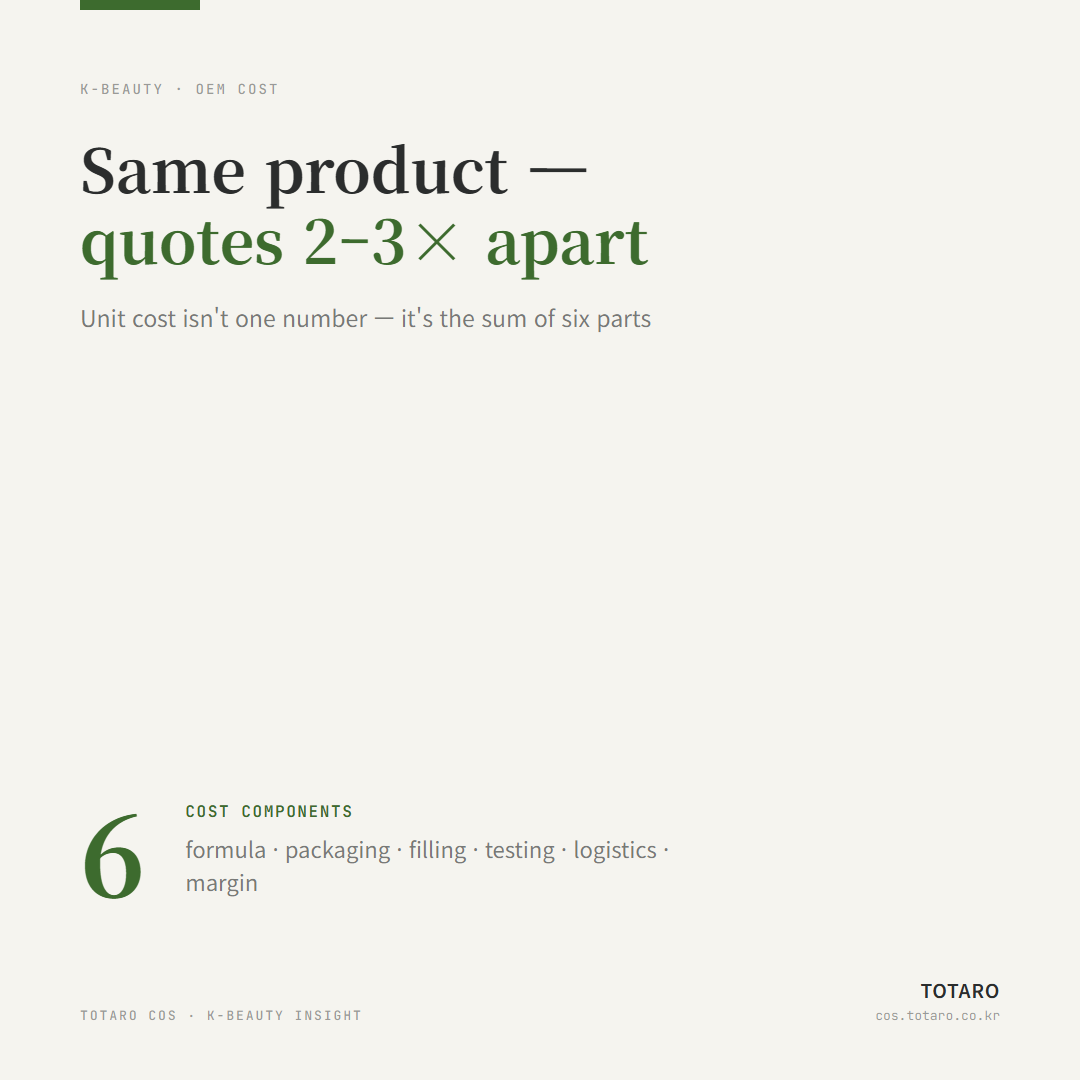
It's common for the same product spec to quote 2–3× apart across OEMs. It isn't gouging — unit cost is the sum of several parts, not one number.
Once you know where cost comes from, the negotiation and cost-down points become visible.
This piece covers:
- What unit cost is made of
- Why OEMs quote differently
- The levers that lower cost (by impact)
- The hidden costs a quote doesn't show
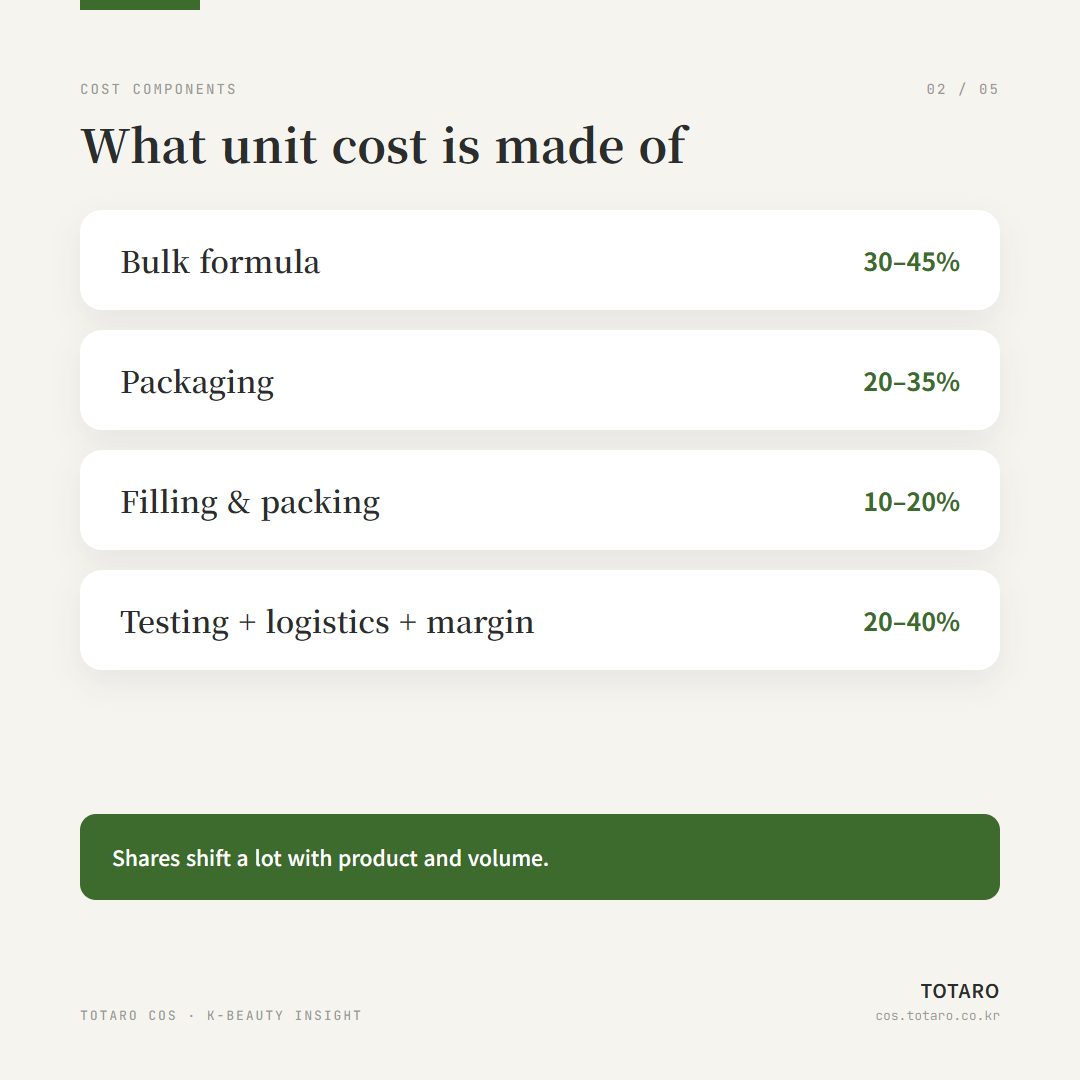
What Unit Cost Is Made Of
| Cost component | What it is | Rough share | Cost-down lever |
|---|---|---|---|
| Bulk formula | Ingredients + R&D | 30–45% | Stock formula, simpler actives |
| Packaging | Container, pump, cap, carton | 20–35% | Stock containers, fewer colors |
| Filling & packing | Line time + labor | 10–20% | Higher volume (spread setup) |
| Testing & certs | Stability, efficacy, regulatory | 5–15% | Reuse existing test data |
| Logistics & duty | Freight, clearance, tariffs | 5–15% | Incoterms, consolidated shipping |
| Margin & overhead | OEM margin + indirect | 10–20% | Volume, relationship |
Shares shift a lot with product and volume.
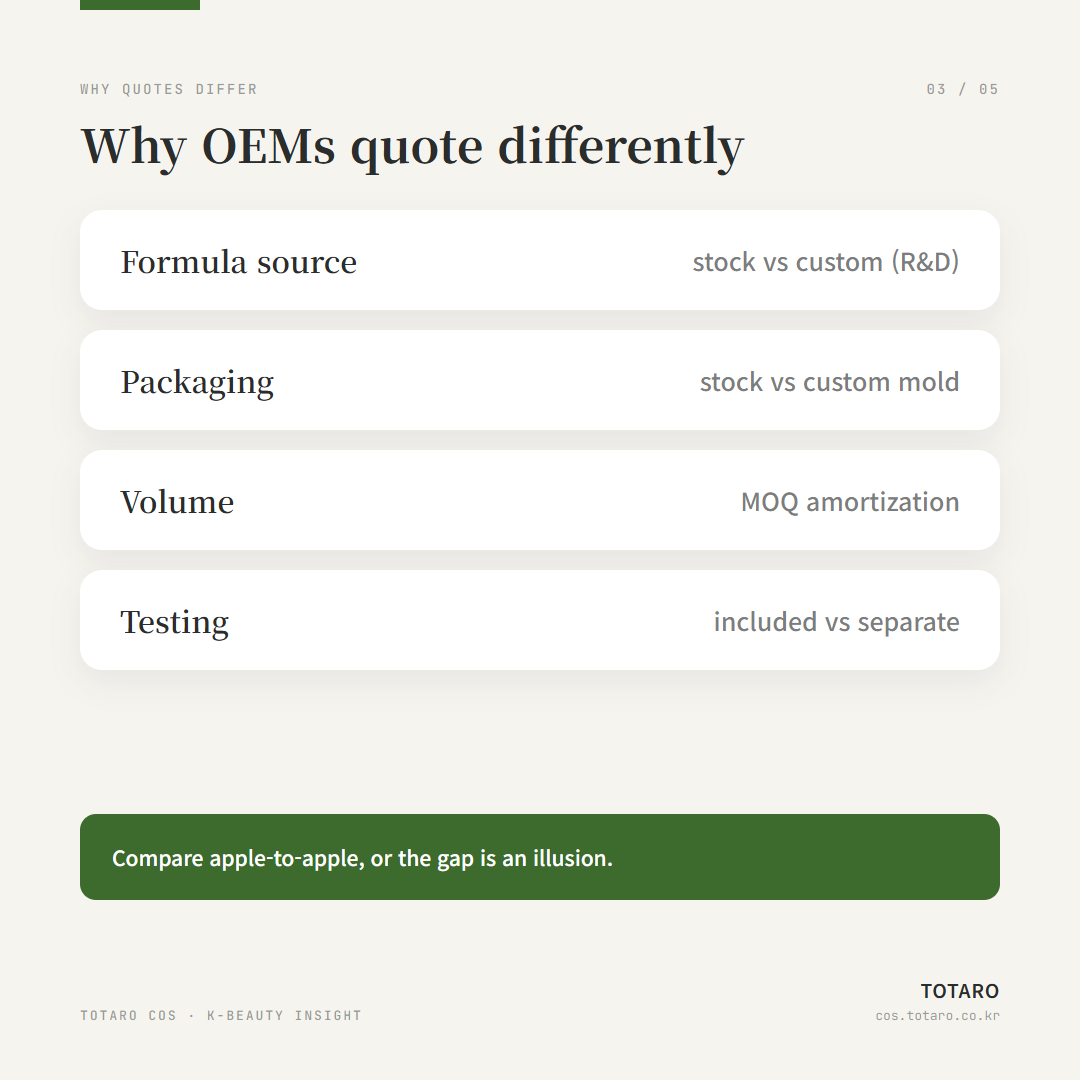
Why OEMs Quote Differently
- Formula source: stock (shared) vs custom (dedicated R&D) — the R&D line decides a lot
- Packaging: stock vs custom mold — mold cost and MOQ change wholesale
- Volume (MOQ amortization): setup and molds are fixed costs — more units means a smaller per-unit slice
- Testing included?: is test cost in the quote, or billed separately?
Unless you compare apple-to-apple (same spec), a 2–3× gap can be an illusion.
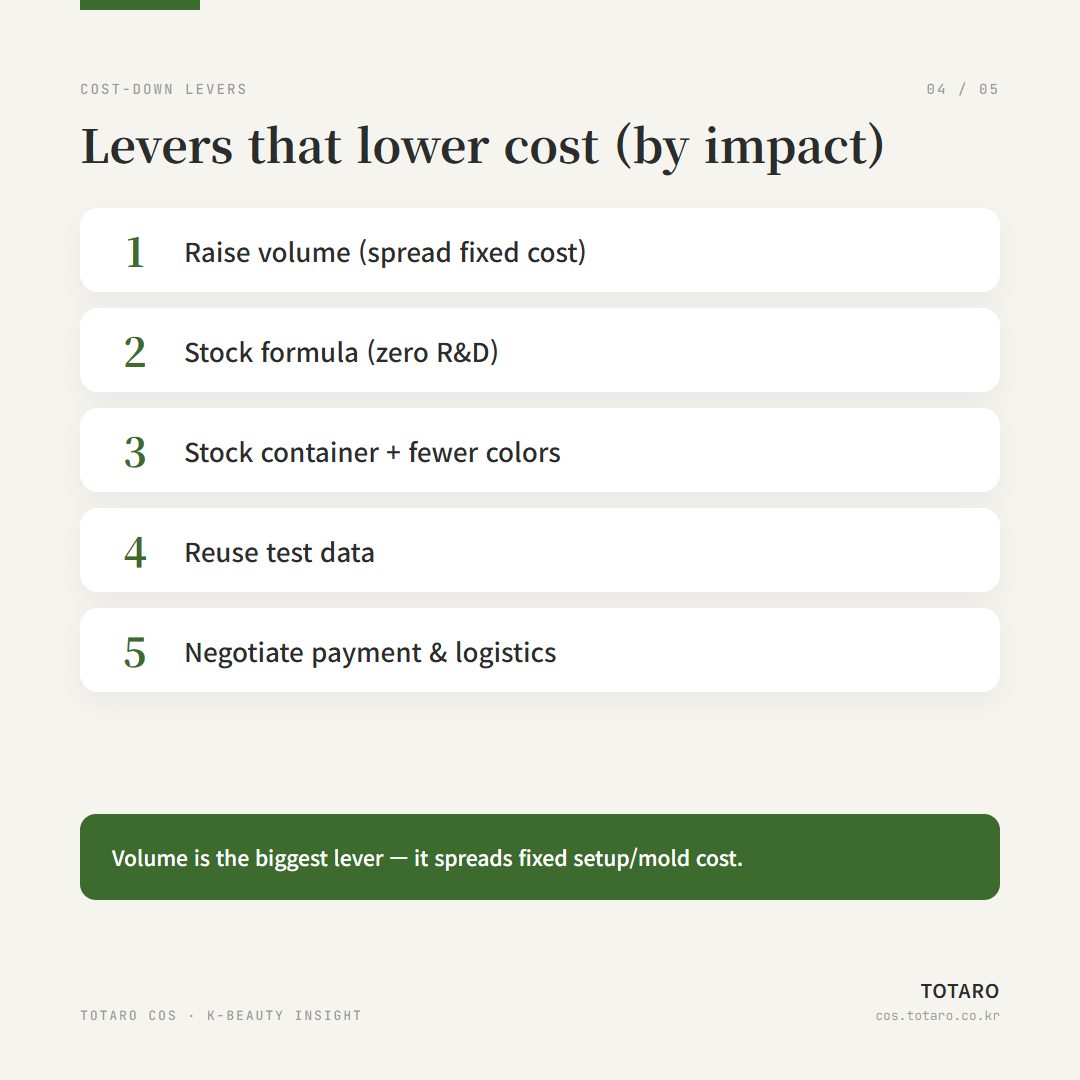
Levers That Lower Cost (by impact)
- Raise volume — spreads setup/mold fixed costs. The biggest lever
- Stock formula — zero R&D cost
- Stock container + fewer colors
- Reuse / share test data
- Negotiate payment & logistics (LC/TT, Incoterms)
Hidden Costs — Not on the Quote
- Mold cost (custom containers), test fees (often billed separately)
- Sample / lab-dip fees, setup charges / minimum balances
- FX swings, label and certificate issuance fees
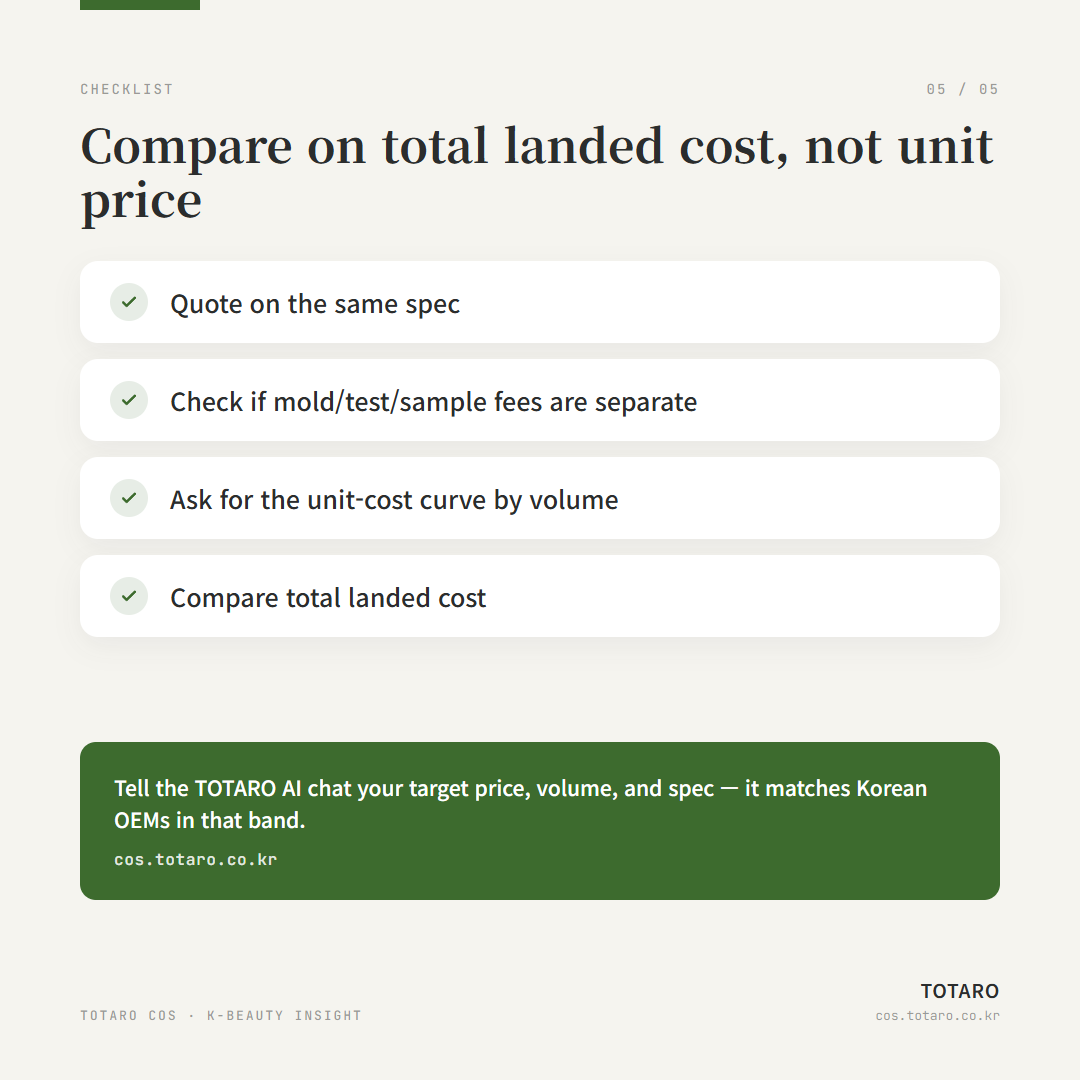
Don't compare on "unit price" alone — compare on total landed cost (logistics and duty included).
Comparison-Quote Checklist
- Compare on the same spec (formula, container, volume, testing scope)
- Confirm whether mold, test, and sample fees are separate
- Ask for the unit-cost curve as volume rises
- Make the final call on total landed cost
How TOTARO's Matching Solves This
Tell the TOTARO AI chat your target unit price, volume, and spec, and it surfaces the formula/packaging combination and Korean OEMs that fit that price band. It turns an apples-to-oranges comparison into apples-to-apples, cutting the quote illusion.