China NMPA Cosmetics Registration — The Last Gate for K-Beauty Exports
May 21, 2026
This piece is a card-news set. Swipe through the carousel above for the full visual breakdown.
TL;DR
Selling Korean cosmetics in mainland China legally requires clearing NMPA (National Medical Products Administration). The classifications, paperwork, and testing are strict enough that buyers cannot really do it without active cooperation from the Korean OEM.
NMPA runs two tracks:
- General (non-special) cosmetics — filing (备案). Faster.
- Special cosmetics — registration (注册). Longer and stricter. Sunscreen, whitening, hair regrowth, anti-acne, tattoo products, etc.
Since the 2021 CSAR reform, a path to animal-testing exemption opened for general cosmetics — under conditions.
This piece covers the classifications, both procedures, exemption conditions, required documents, and timelines.
Two Classes — General vs Special Cosmetics
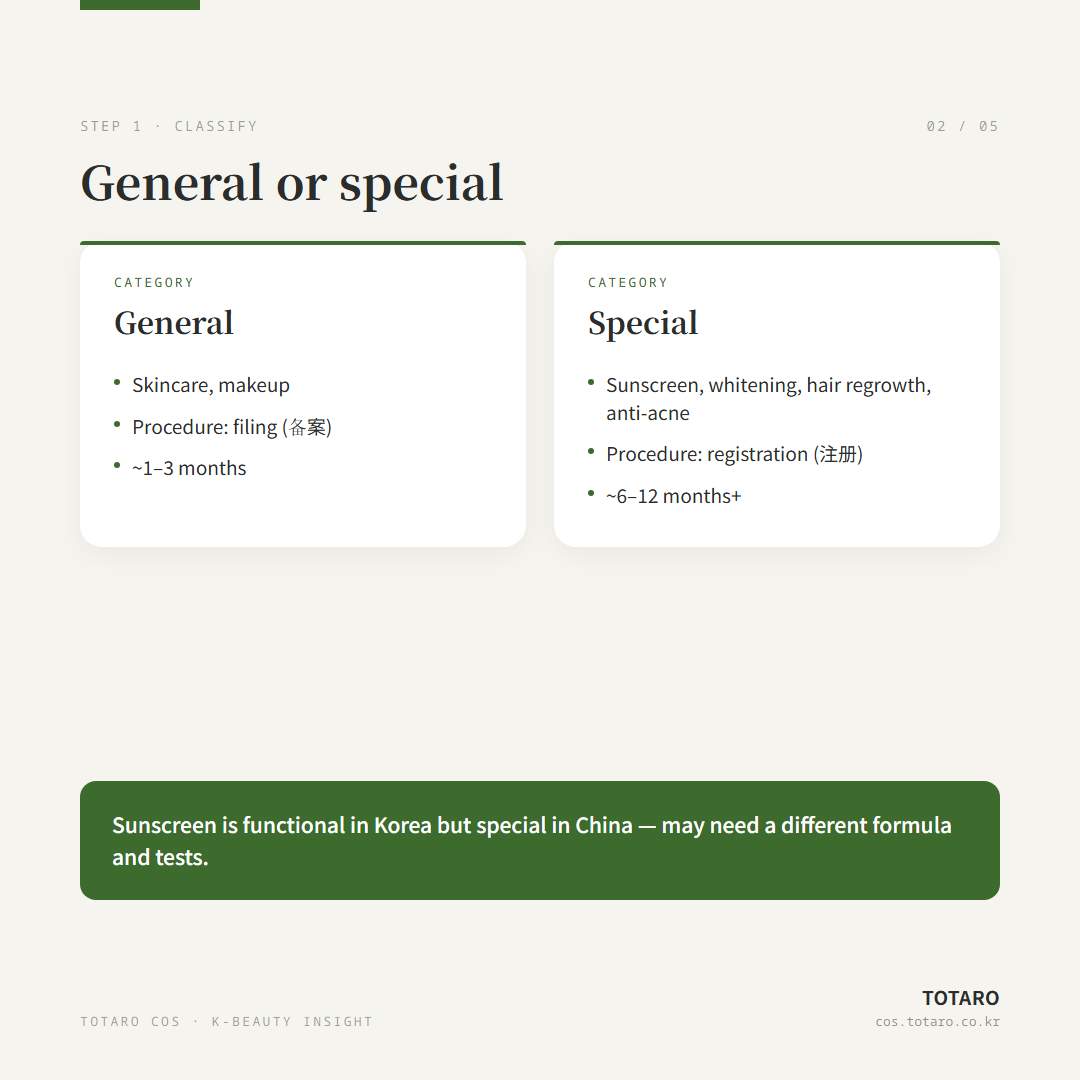
| Item | General | Special |
|---|---|---|
| Procedure | Filing (备案) | Registration (注册) |
| Typical categories | Skincare, makeup | Sunscreen, whitening, hair regrowth, anti-acne, tattoo |
| Lead time | ~1–3 months | ~6–12 months+ |
| NMPA tests | Safety assessment | Safety + efficacy |
| China RP (Responsible Person) | Required | Required |
Pin the product class first — sunscreen is a functional cosmetic in Korea but a special cosmetic in China.
General Cosmetics Filing
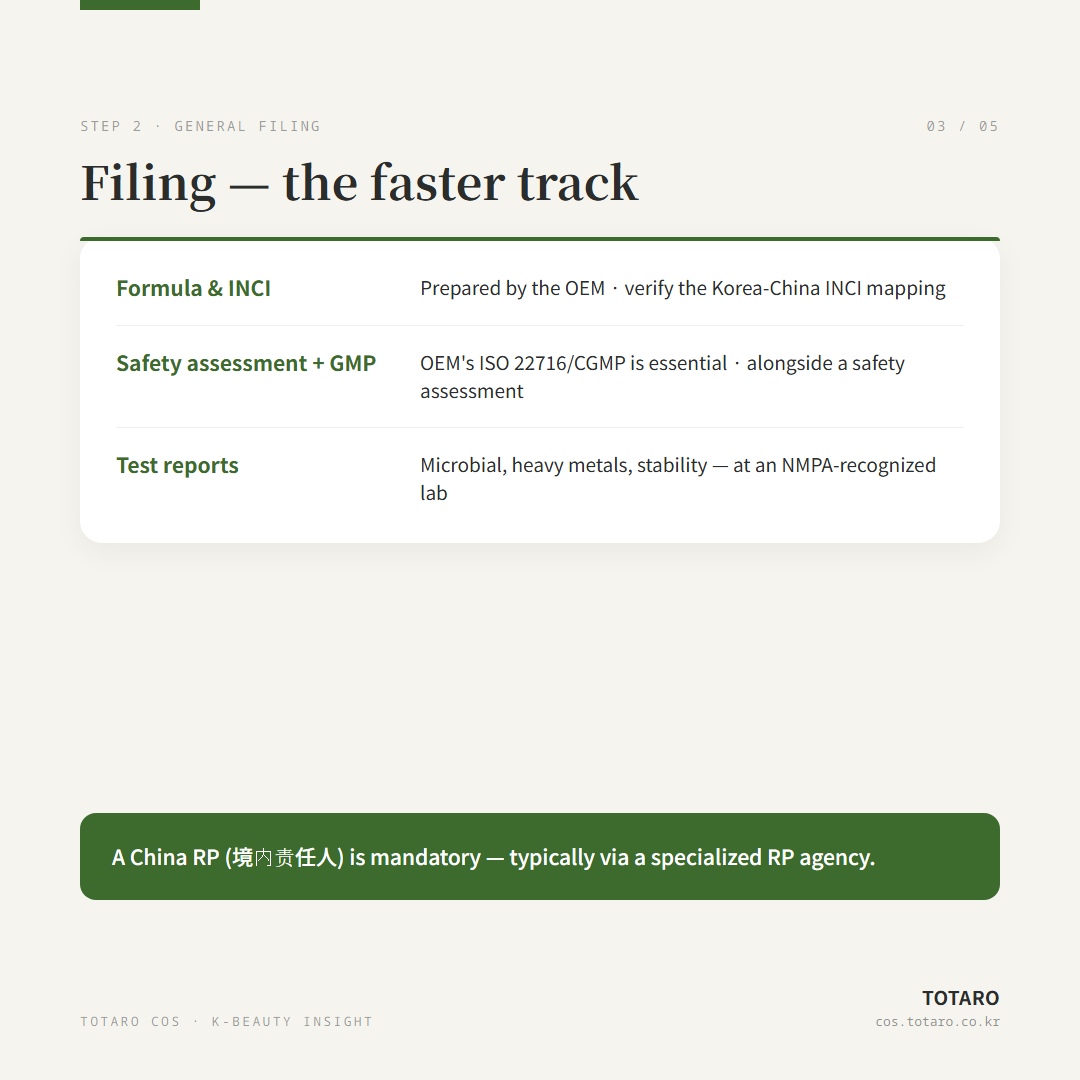
New general cosmetics (toners, serums, makeup) go through NMPA filing.
- Lead time: ~1–3 months
- Core documents: formula, INCI, safety assessment report, label design, RP authorization
- Testing: microbial, heavy metals, stability — at an NMPA-recognized lab
- Sales allowed once filing is complete
Special Cosmetics Registration
Sunscreen, whitening, hair regrowth, anti-acne, tattoo, hair-loss prevention, body-hair removal — these are special cosmetics, going through the stricter registration (注册) procedure.
- Lead time: 6–12 months or more
- Extra testing: efficacy clinical trials, additional safety
- Extra documents: efficacy evaluation, stability data
- Sunscreen = special: SPF claims require efficacy testing plus distinct labeling
Korean OEMs often have to make a separate China-spec formula.
The 2021 Shift — Animal-Testing Exemption
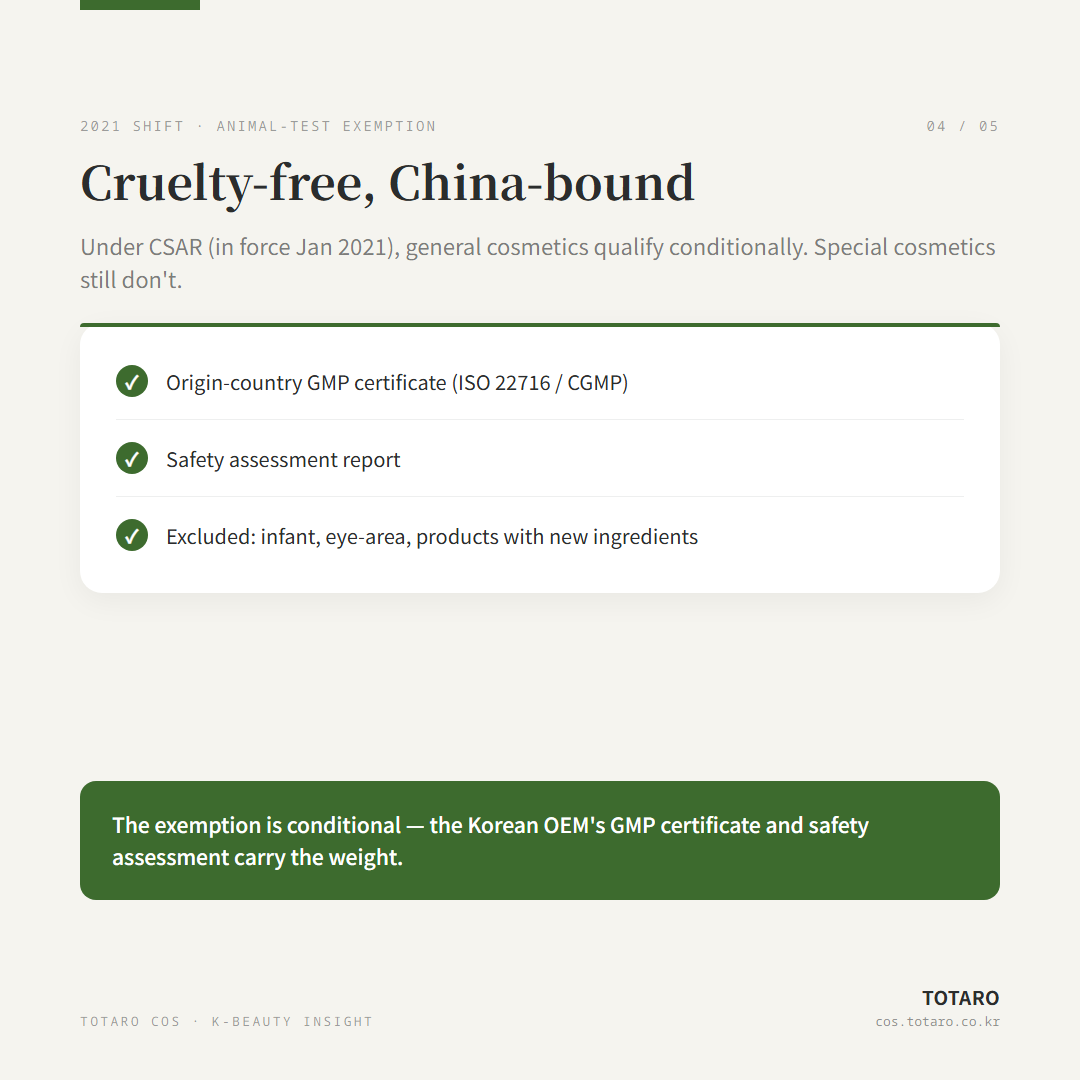
CSAR (化妆品监督管理条例, in force from January 2021) opened a path to animal-testing exemption for general cosmetics.
Conditions (all required):
- A GMP certificate from the country of origin (e.g., a Korean OEM's ISO 22716 or CGMP)
- A safety assessment report
- Excluded: infant products, eye-area products, products with newly used ingredients or new preservatives
Special cosmetics are still subject to animal testing — they are not part of the exemption.
The exemption opened the door for global cruelty-free brands to enter China, but the conditions are strict — a Korean OEM with the GMP certificate plus a safety assessment is the key.
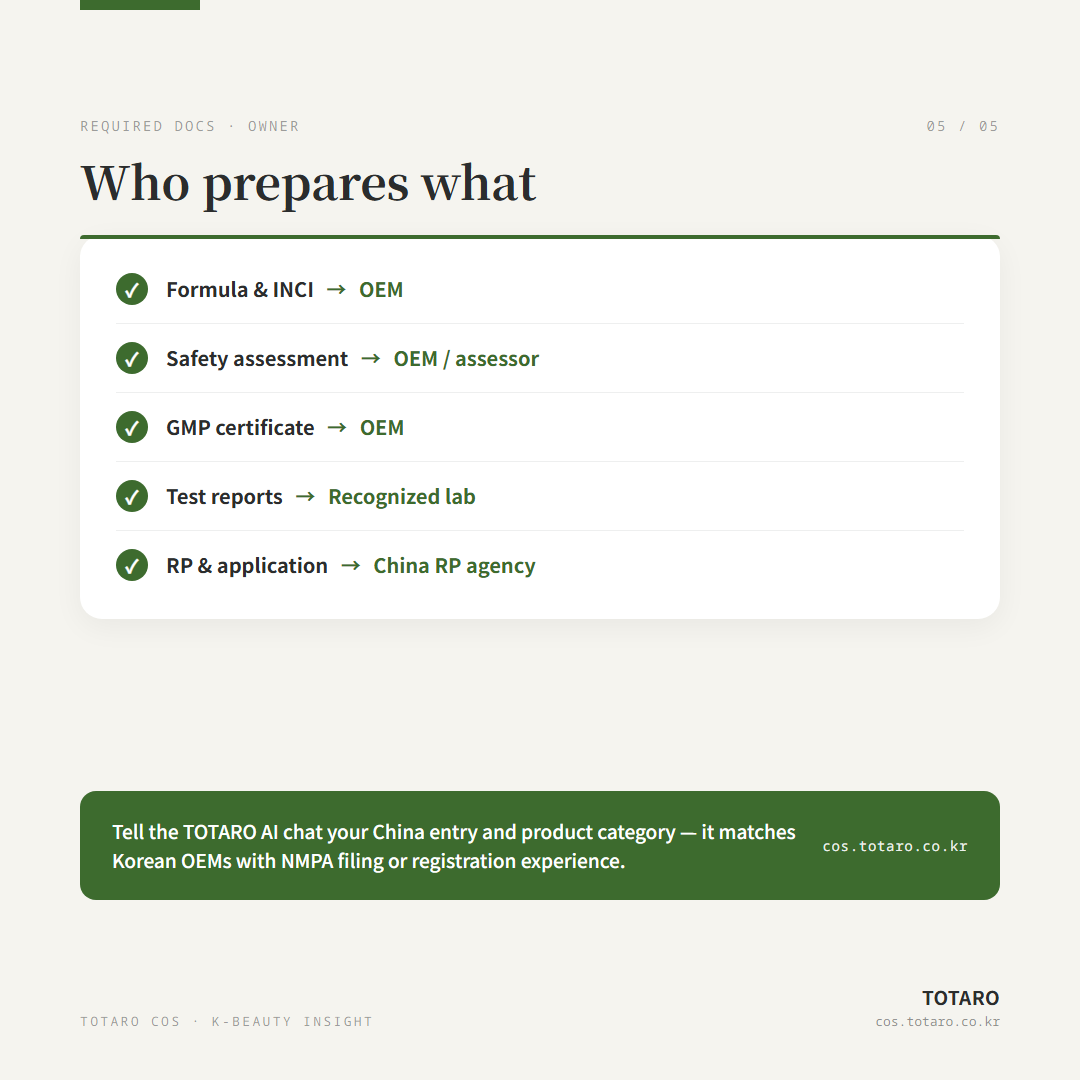
Required Documents · Who Prepares What
| Item | Prepared by |
|---|---|
| Formula, INCI | OEM |
| Safety assessment | OEM or licensed safety assessor |
| GMP certificate (ISO 22716, etc.) | OEM |
| Test reports | NMPA-recognized lab |
| Chinese-language label | Buyer + designer |
| RP authorization | Chinese RP agency |
| Filing/registration application | RP agency (acts on your behalf) |
A China RP (境内责任人, domestic Responsible Person) is mandatory — usually contracted with a specialized RP agency.
How TOTARO's Matching Solves This
Tell the TOTARO AI chat your China entry plan and product category, and it surfaces Korean OEMs with NMPA filing or registration experience, holding the CGMP / ISO 22716 certificate needed for the animal-testing exemption. For special cosmetics (sunscreen, etc.), only OEMs with registration experience are surfaced — wrong-fit ones are filtered out before quoting.