K-Beauty OEM Sampling & Development — The 6 Steps from Inquiry to Production
May 17, 2026
This piece is a card-news set. Swipe through the carousel above for the full visual breakdown.
TL;DR
When buyers develop a cosmetic with a Korean OEM, the hardest part isn't price or MOQ — it's not knowing what actually happens between the first inquiry and the production order.
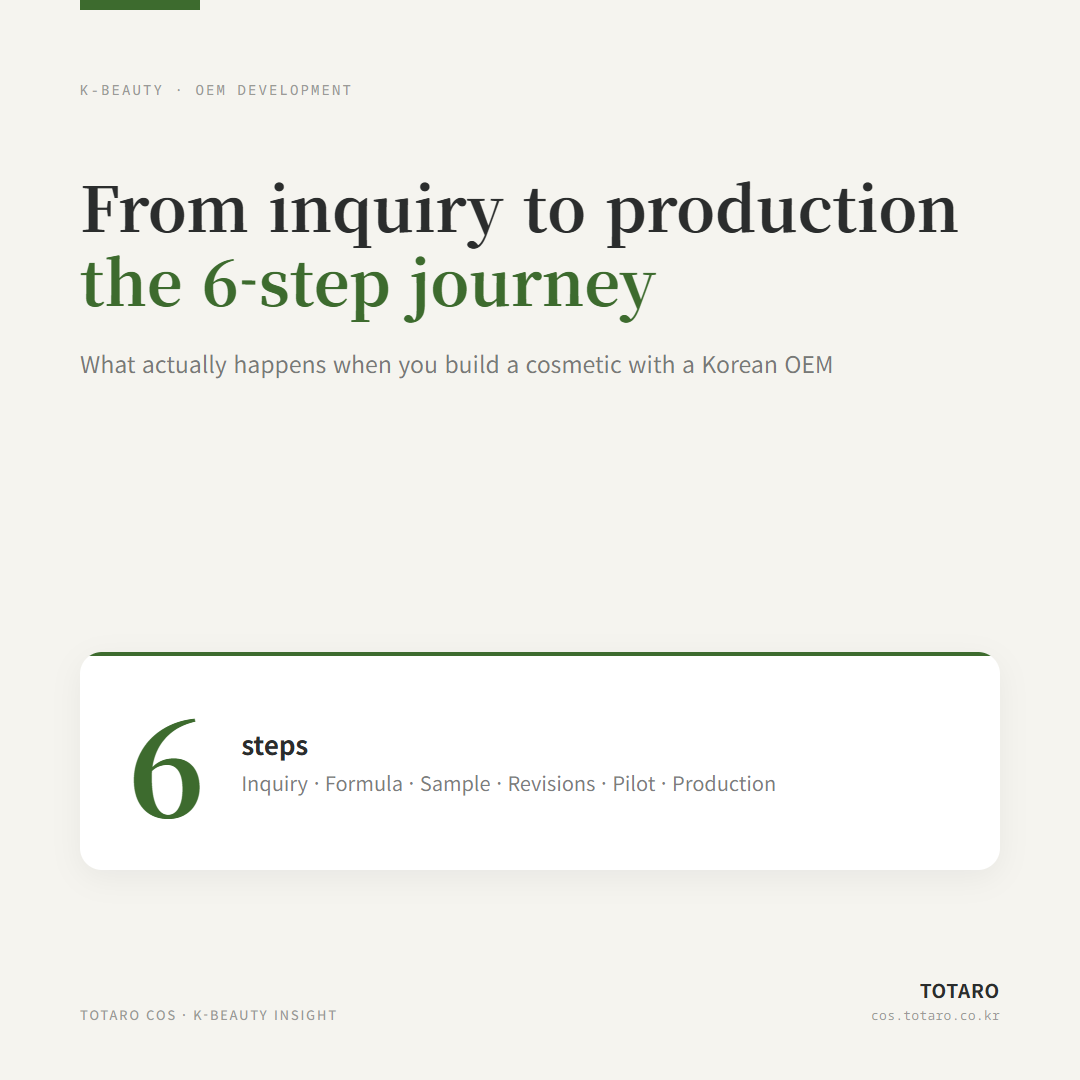
The full journey is six steps:
Inquiry & quote → Formula choice → Lab sample → Sample revisions → Pilot batch → Production order
This piece covers what changes hands at each step, the cost and lead time, and the mistakes buyers make.
Steps 1–2 — Inquiry and Formula Choice
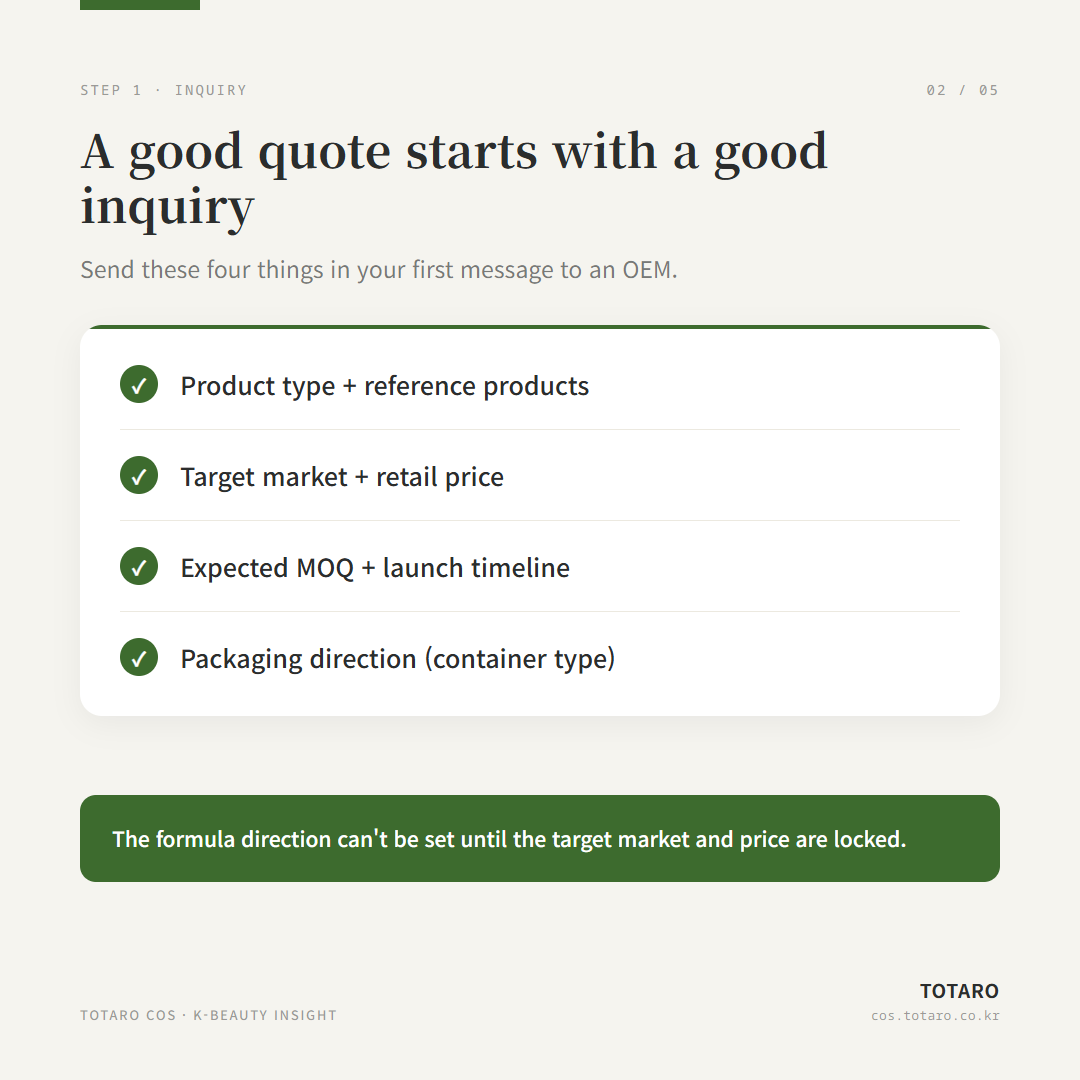
A good quote starts with a good inquiry. When you first contact an OEM, send:
- Product type and reference products (the benchmark)
- Target market and target retail price
- Expected MOQ and launch timeline
- Packaging direction (container type)
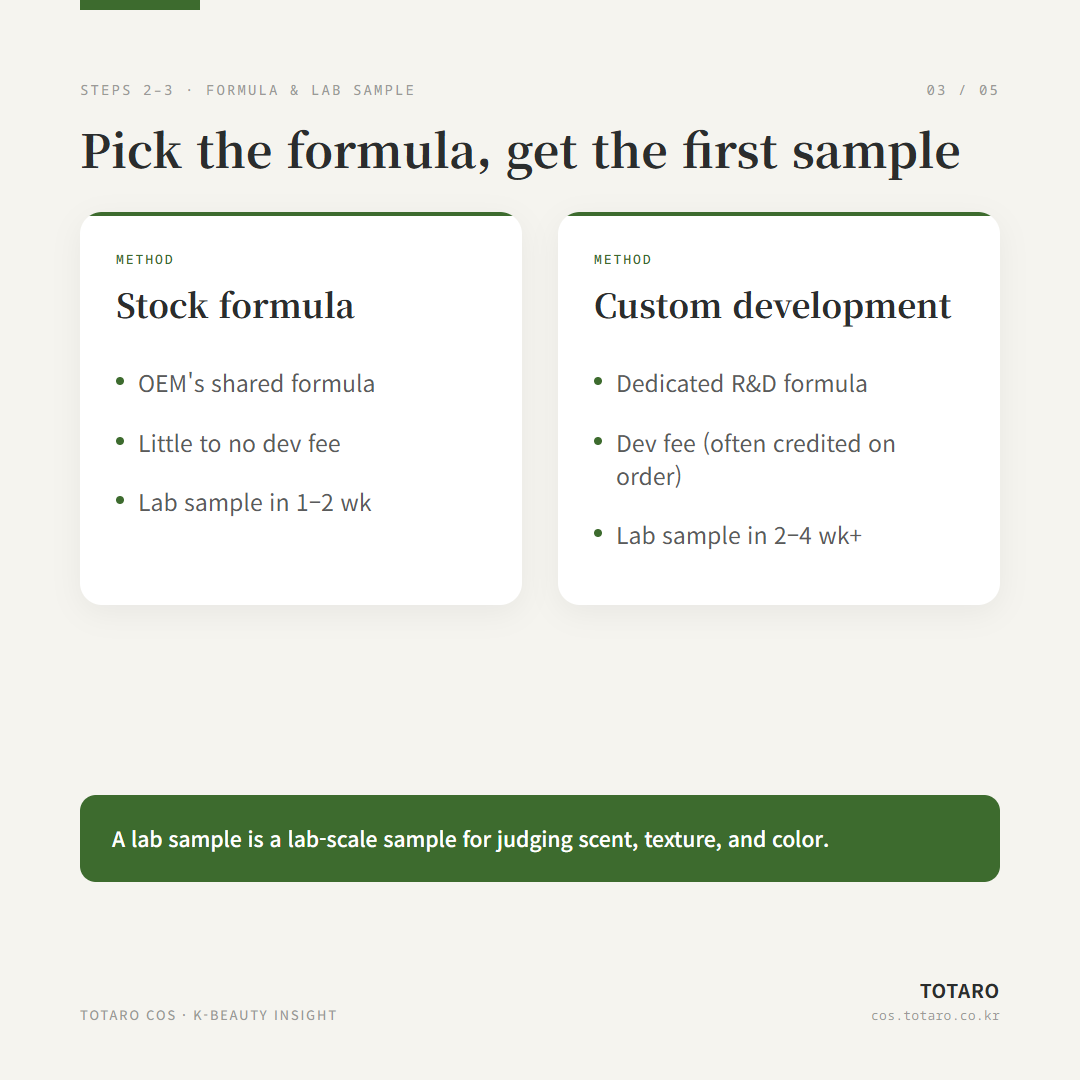
The formula goes one of two ways:
- Stock formula — a shared formula the OEM already developed. Little to no development fee, fast. Differentiation is limited.
- Custom development — dedicated R&D. A development fee applies, longer timeline. High differentiation.
You have to lock the target market and price band before the formula direction can be set.
Step 3 — The Lab Sample
Once the formula is decided, the OEM makes a lab sample (the first sample).
- Stock formula: 1–2 weeks, usually free or low-cost
- Custom: 2–4 weeks or more; a development fee may apply (many OEMs credit or waive it once you commit to an order)
A lab sample is made at lab scale — it is for evaluating scent, texture, and color payoff. Sample courier costs are usually the buyer's.
Step 4 — Sample Revisions
A first sample almost always triggers revisions — scent, texture, color payoff, active concentration.
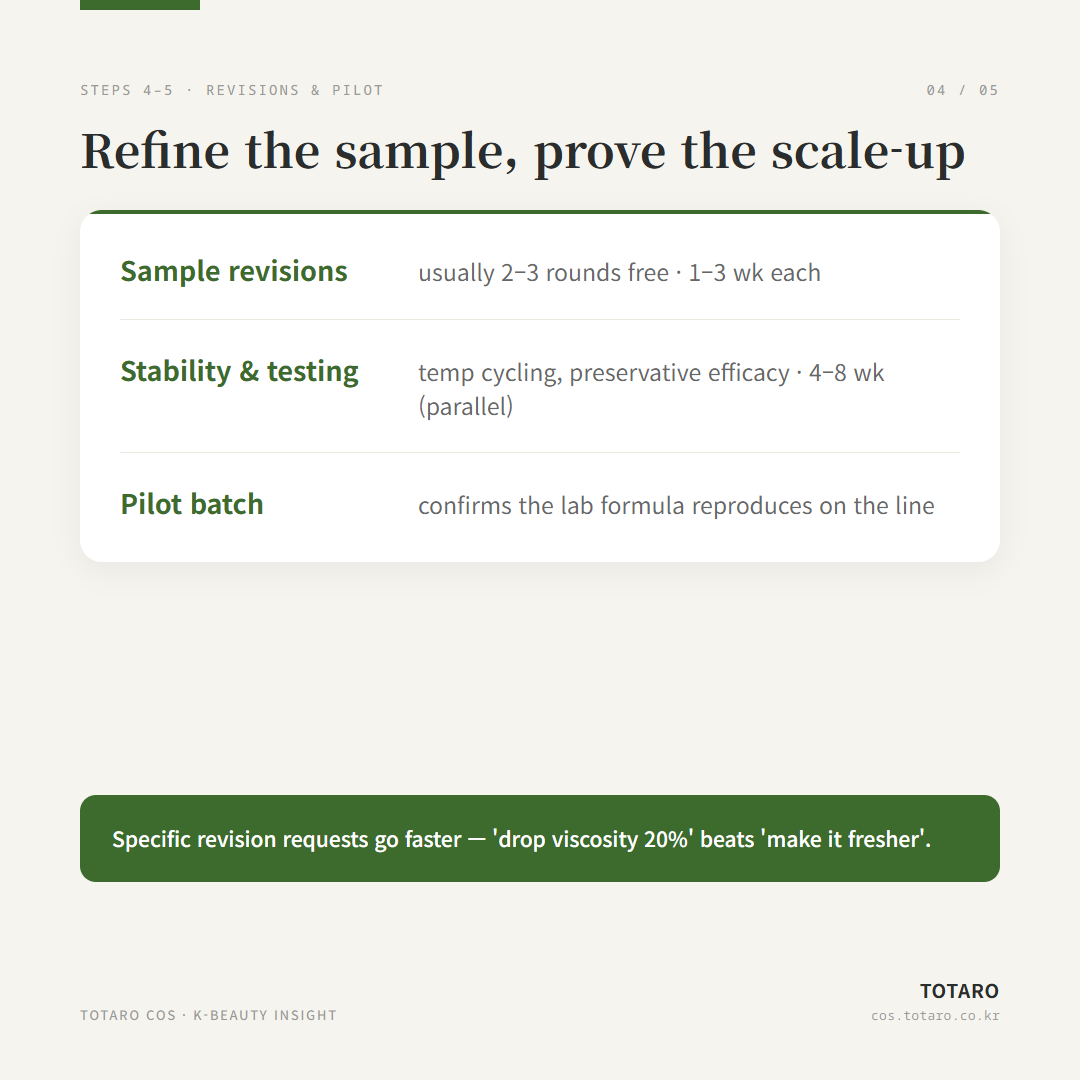
- Usually 2–3 revision rounds are free
- Each round runs 1–3 weeks
- Beyond that, rounds often carry a per-round fee
"The more specific the revision request, the faster it goes. 'Make it a bit fresher' costs a round; 'drop the viscosity 20% and make it fragrance-free' saves one." — Korean OEM development team, May 2026
Steps 5–6 — Pilot Batch and Production Order
Once the sample is locked, stability and safety testing runs (temperature cycling, preservative efficacy, etc. — 4–8 weeks, can run in parallel).
Then the pilot batch — a small production run that confirms the lab formula reproduces on the production line. (Stock formulas sometimes skip this and go straight to mass production.)
Finally, the production order — you order at MOQ volume and the lead-time clock starts.
Cost & Lead Time by Step
| Step | Lead time | Cost |
|---|---|---|
| Inquiry & quote | 3–7 days | Free |
| Lab sample (Stock) | 1–2 wk | Free–low |
| Lab sample (Custom) | 2–4 wk+ | Dev fee (often credited on order) |
| Sample revisions | 1–3 wk per round | 2–3 rounds free |
| Stability & testing | 4–8 wk (parallel) | Separate |
| Pilot batch | 2–4 wk | Separate |
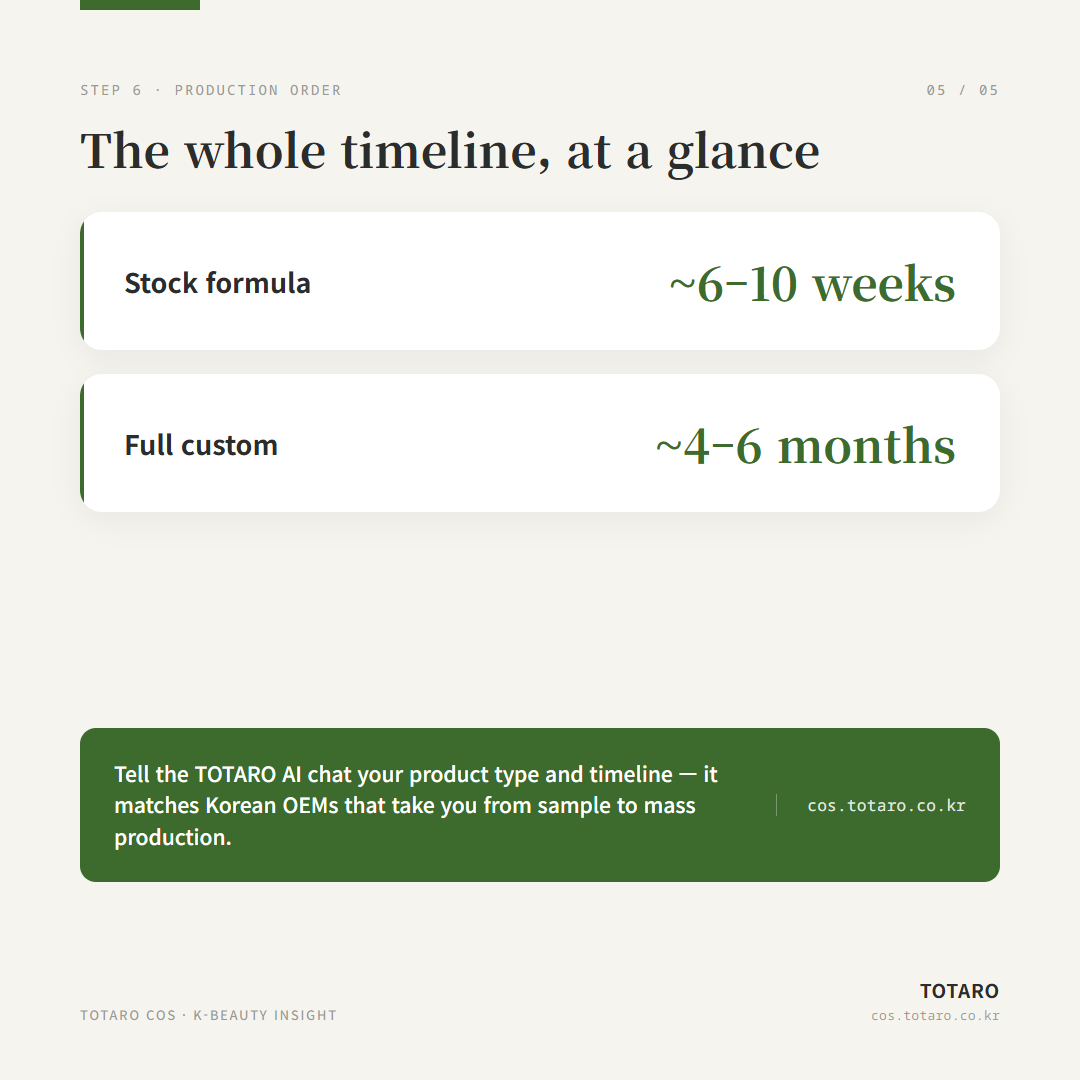
Total: a stock formula runs ~6–10 weeks; full custom runs ~4–6 months.
How TOTARO's Matching Solves This
Tell the TOTARO AI chat your product type and timeline, and it surfaces OEMs that carry you from sample development through to mass production under one roof. It compares custom-development capability, development-fee policy, and revision-round terms up front — so only OEMs aligned with your direction remain before you ever request a sample.