OEM vs ODM vs Private Label — K-Beauty Manufacturing Decision Tree
May 8, 2026
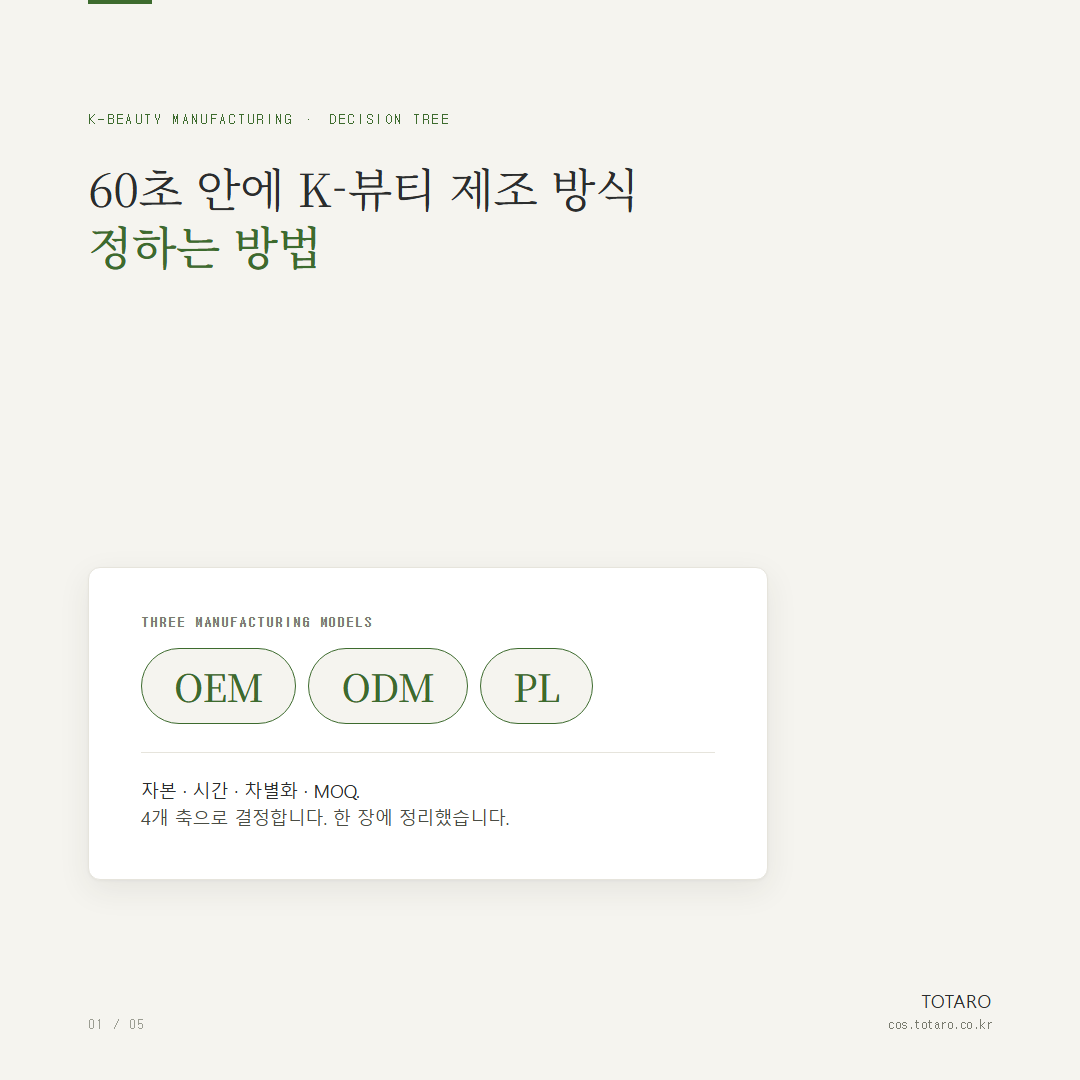
This piece is a card-news set. Swipe through the carousel above for the full visual breakdown.
TL;DR
K-beauty manufacturing comes in three models — OEM, ODM, and Private Label. The same word means different things across markets, so we anchor on who owns the formula and who carries the risk.
This piece covers:
- The precise definition of each of the three models
- A capital · time · differentiation · MOQ matrix to decide
- Where Korea's ODM big three (Cosmax, Kolmar Korea, Kosmecca) sit
- A 60-second test for your own brand
Definitions — Three Models
| Model | Formula owner | Label owner | Risk carrier |
|---|---|---|---|
| OEM (Original Equipment Manufacturing) | Buyer | Buyer | Buyer (R&D included) |
| ODM (Original Design Manufacturing) | Manufacturer | Buyer | Shared |
| Private Label | Manufacturer (off-the-shelf) | Buyer (label only) | Manufacturer |
"Private Label" is sometimes used as an umbrella that includes ODM. In K-beauty, the term is reserved for off-the-shelf formula + label change only.
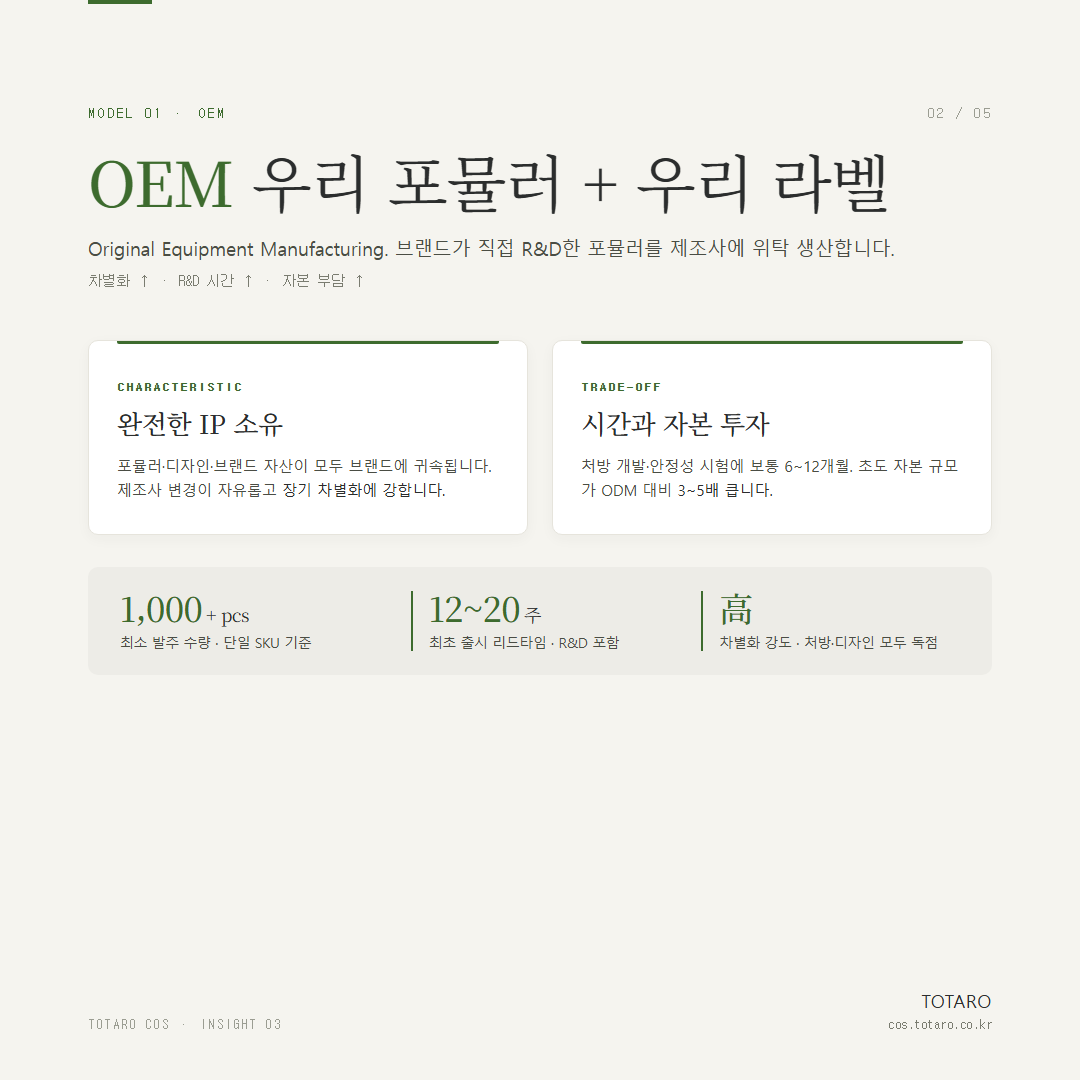
OEM — Your Formula, Your Label
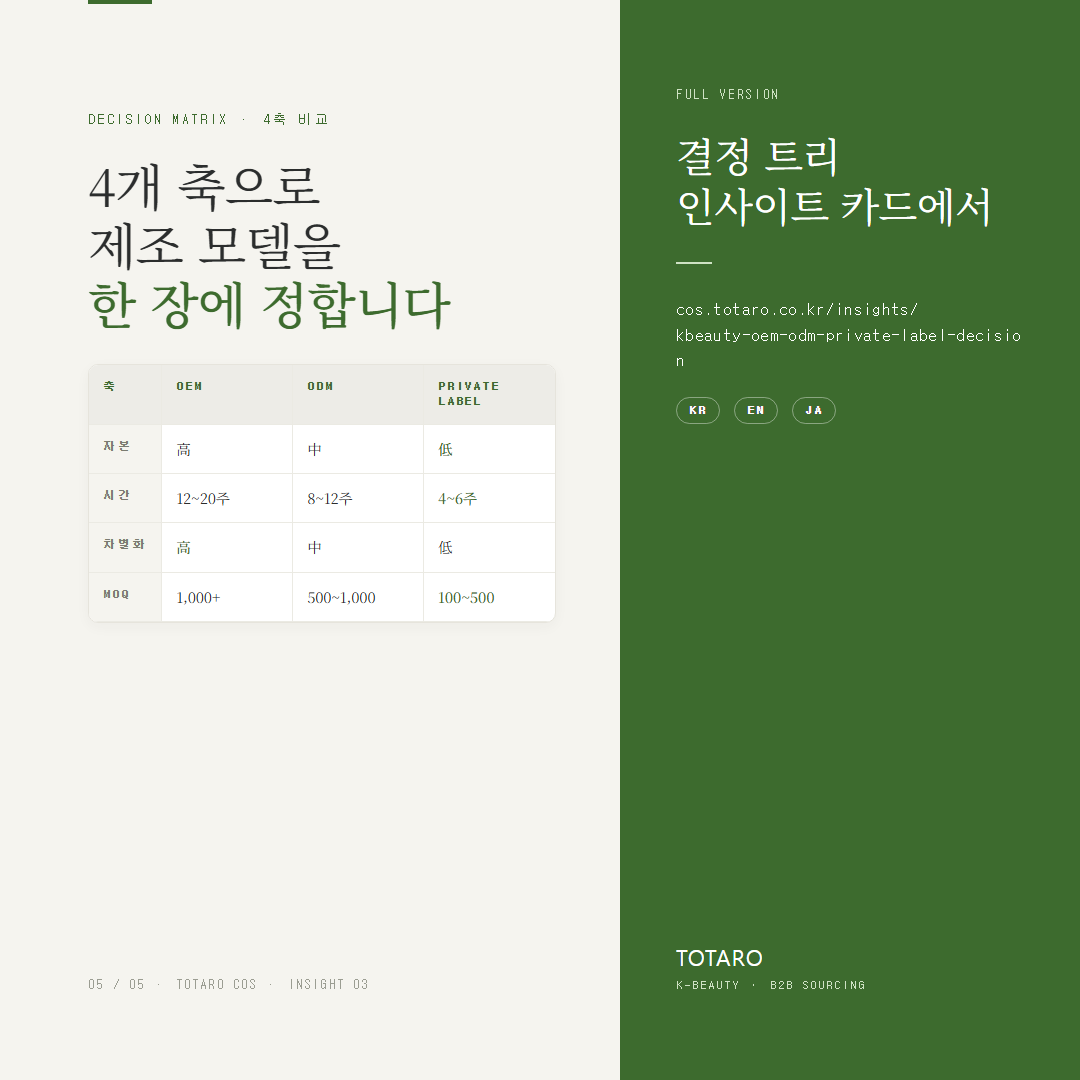
MOQ 1,000+ units / lead time 12–20 weeks / differentiation HIGH
The buyer brings the formula (or develops it with a chemist/lab); the manufacturer provides only the production line.
- Pro: Full differentiation. Patents and trade secrets are possible.
- Con: R&D takes time (6–12 months typical), prototype cost is high ($5K–$30K), MOQ is large.
- Fit: Brand-new categories, sufficient capital and time, long-term branding plays.
Korea has roughly 200–300 OEM-only lines, mostly small and mid-sized factories.
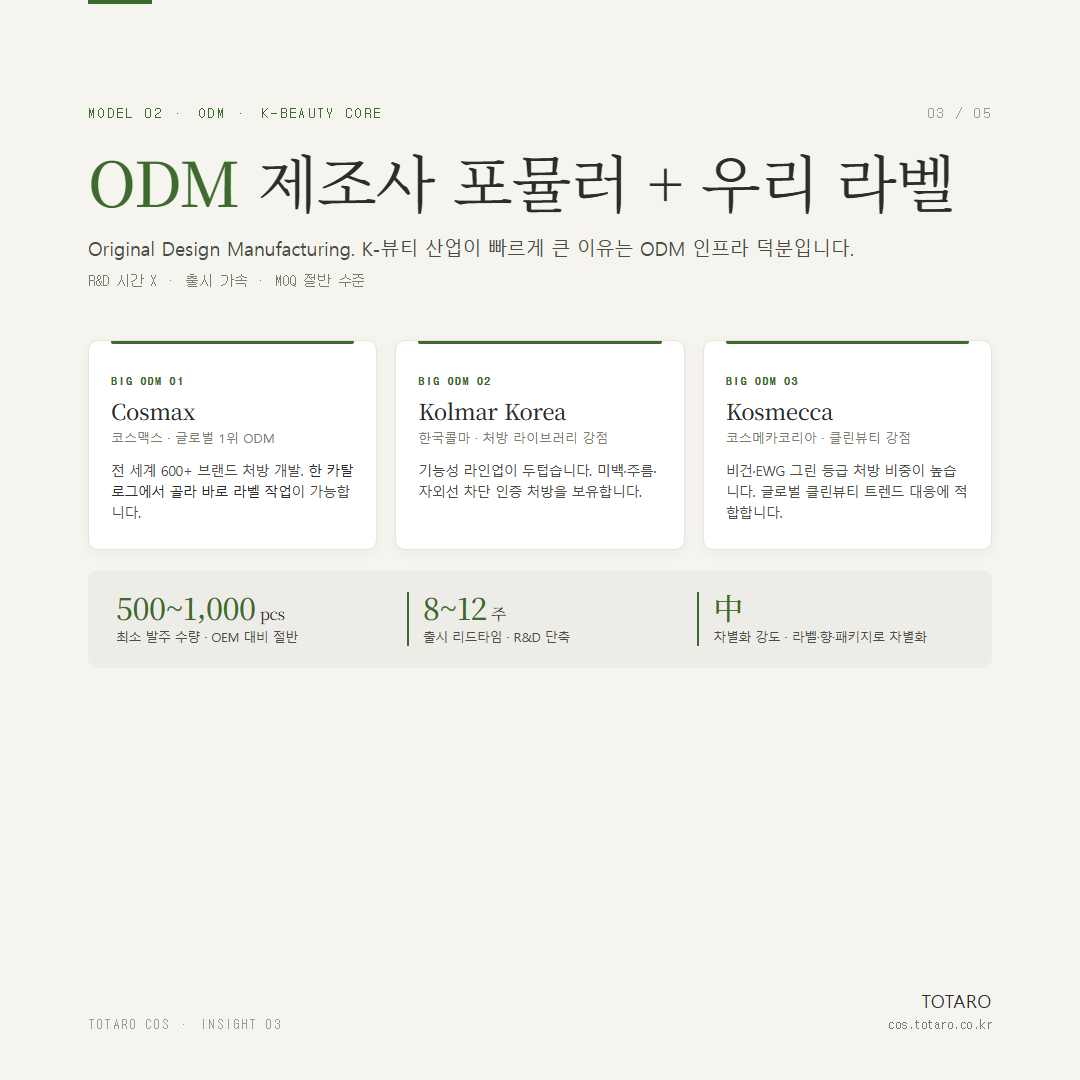
ODM — Manufacturer Formula, Your Label
MOQ 500–1,000 units / lead time 8–12 weeks / differentiation MEDIUM
The manufacturer's own R&D formula is licensed to the buyer for labeling and positioning. This is the dominant K-beauty model.
- Pro: Zero R&D time, fast launch, validated formula (clinical data often available).
- Con: Other brands may use the same formula (exclusivity is a separate contract).
- Fit: When marketing and brand are the differentiation.
Korea's ODM Big 3
| ODM | Strength | Global clients |
|---|---|---|
| Cosmax | Skincare R&D, 600+ brands worldwide | L'Oréal, Estée Lauder, Unilever |
| Kolmar Korea | Color cosmetics & sun care, #1 in MFDS filings | Laneige, Hera, Shiseido |
| Kosmecca | Animal capsules, daily care specialty | Nivea, Kanebo |
Plus 30–50 specialty ODMs (Cosmecca, COSMAX BTI, Kolmar BNH, and others).
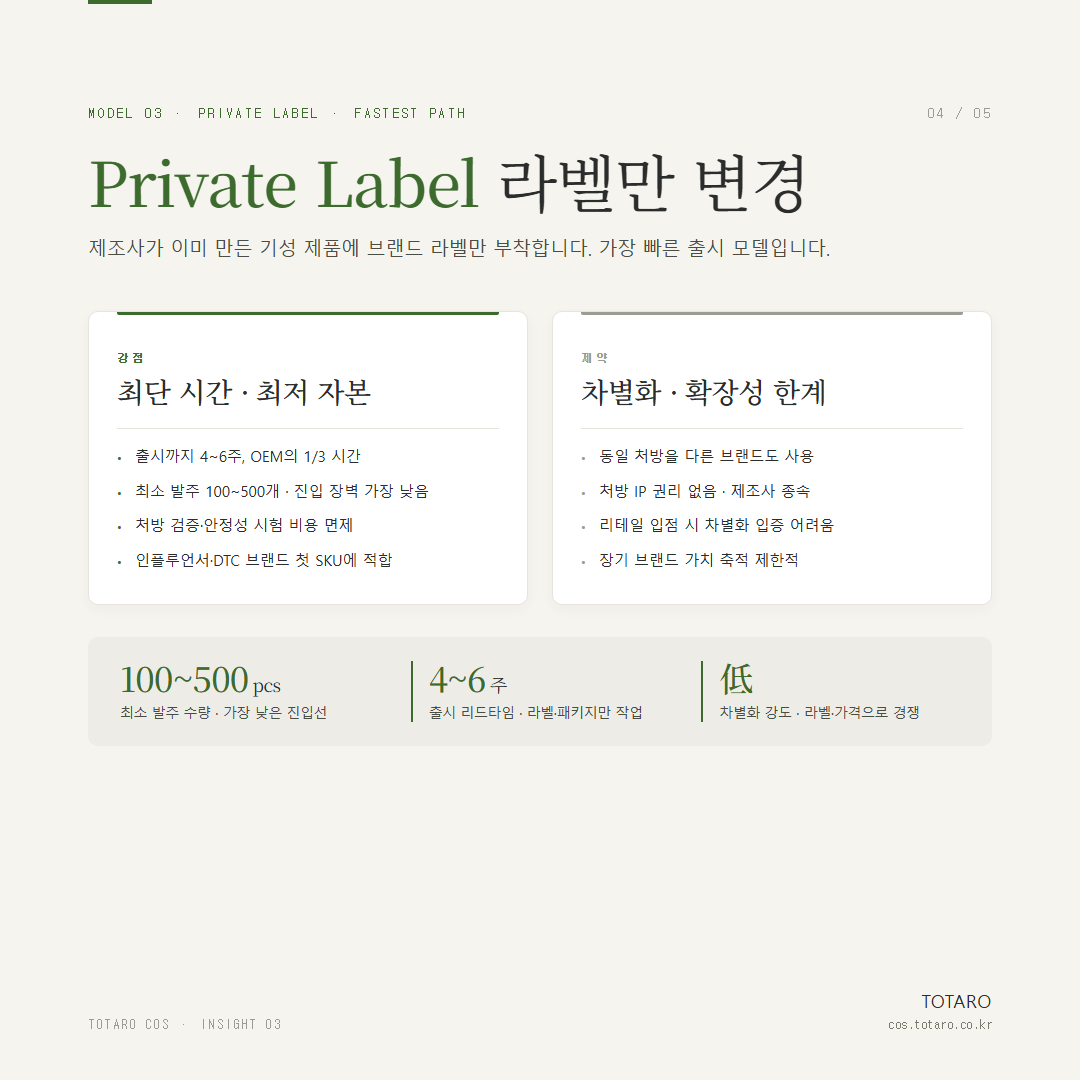
Private Label — Off-the-Shelf + Label Only
MOQ 100–500 units / lead time 4–6 weeks / differentiation LOW
You pick from the OEM's stock-formula catalog and change only the label. Fastest path to market. (See the MOQ 1,000-unit barrier — Workaround #2 — for details.)
- Pro: Fastest launch, lowest MOQ, validated base.
- Con: Low differentiation, thinner margins.
- Fit: Market-test phase, price competition, quick cash flow.
Four-Axis Decision Matrix
Score your brand from 1 to 5 on each axis. The total maps to a model:
| Axis | 1 (low) | 5 (high) |
|---|---|---|
| Capital | <$10K | >$100K |
| Time | <2 months | >12 months |
| Differentiation | Fast entry | New category |
| MOQ | 100–500 units | 5,000+ units |
Decision Bands
- Total 4–8 → Private Label
- Total 9–14 → ODM
- Total 15–20 → OEM
Differentiation 5 + Capital 1 is a contradiction. The next move is fundraising, not OEM entry.
Next Decision
Once you pick OEM, the next question is supplier verification — how to qualify a manufacturer's certifications, facility, and QC in 5 minutes. See: