K-Beauty MOQ 1,000-Unit Barrier — Why Indie Brands Get Ignored
May 8, 2026
This piece is a card-news set. Swipe through the carousel above for the full visual breakdown.
TL;DR
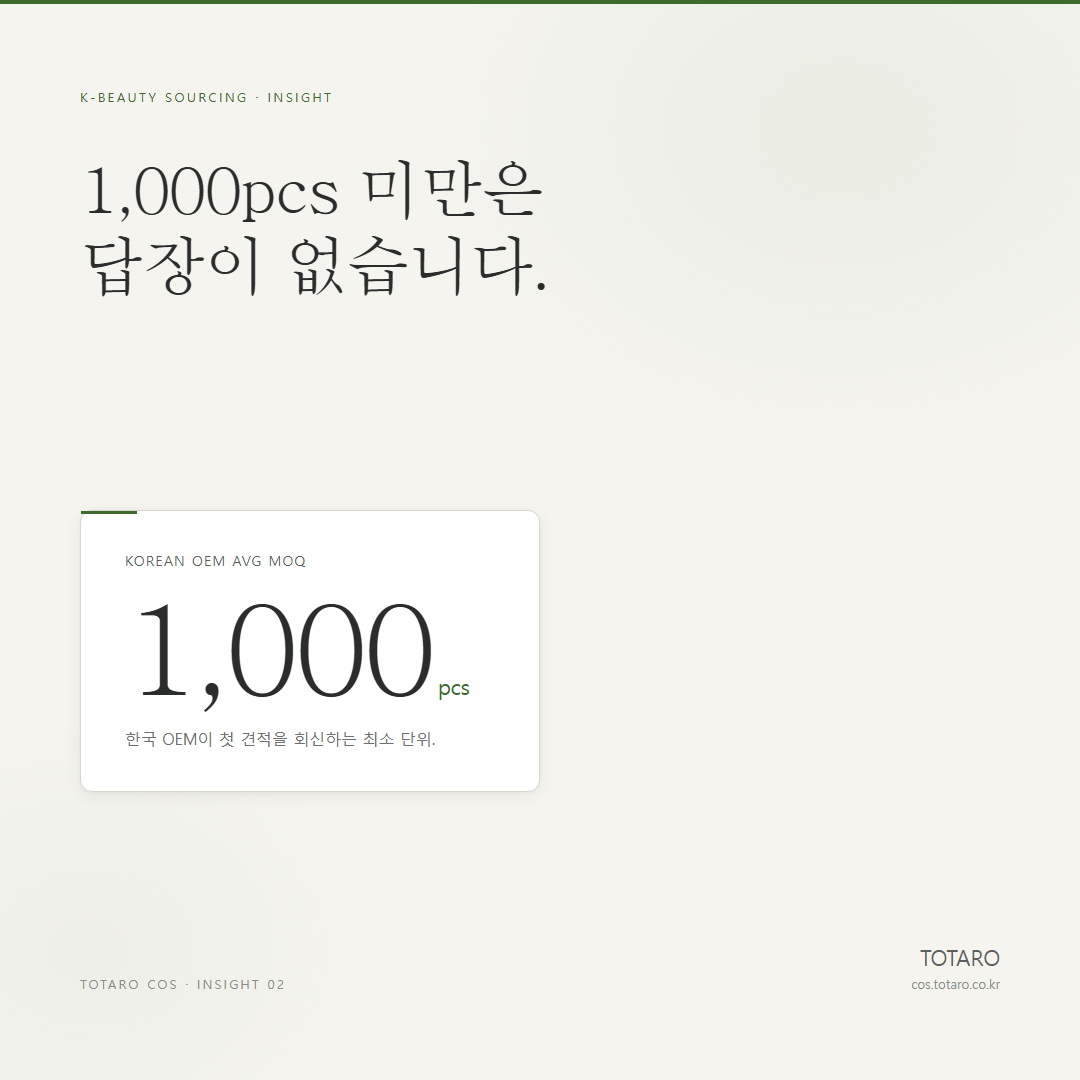
Korean cosmetics OEMs average 1,000–3,000 units per order. When an indie founder sends a 500-unit RFQ and gets no reply, it isn't rudeness — it's a cost-structure outcome.
This piece covers:
- Why 1,000 units is the rational floor for Korean OEMs
- Three workarounds that get you under 1,000 units
- The MOQ / lead-time / differentiation trade-offs of each
Why 1,000 Units Is the Floor
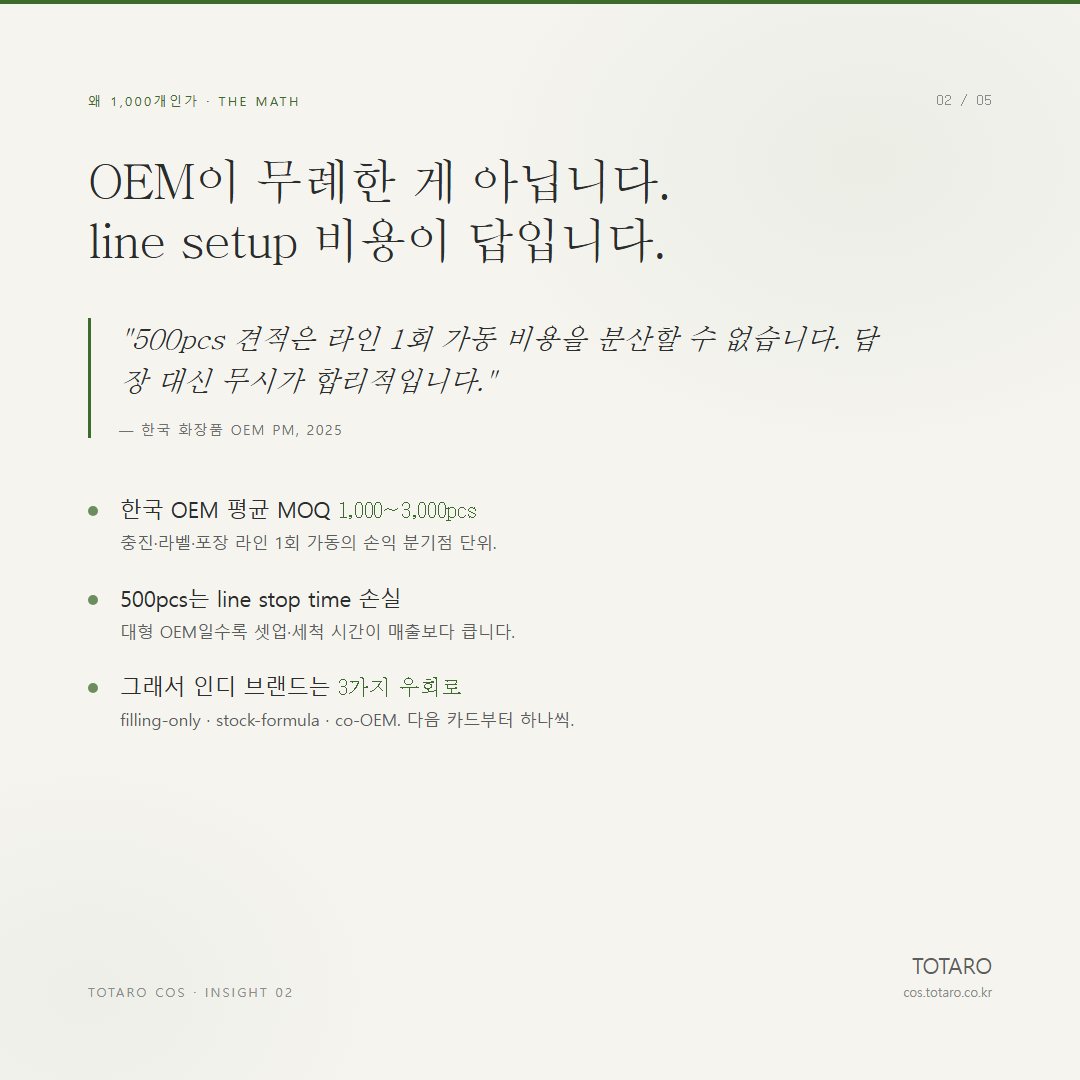
Cosmetic manufacturing lines run on three blocks: setup, cleaning, analysis. Each setup takes 4–8 hours; during that window, the line cannot run another product. That's line stop time — and it's the dominant cost driver for small batches.
| Line tier | Hourly stop cost | Daily loss |
|---|---|---|
| Premium OEM | $300–500/h | $2,400–4,000 |
| Mid-tier | $150–250/h | $1,200–2,000 |
| Indie-friendly | $80–150/h | $640–1,200 |
A 500-unit quote has to absorb that line-stop loss into the unit price — so the unit cost ends up 2–3× the going rate. The buyer doesn't pay; the OEM wastes time quoting. Silence is the rational response.
"It isn't that we forgot to reply. Stopping the line and quoting itself is the loss." — Korean OEM PM, April 2026 interview
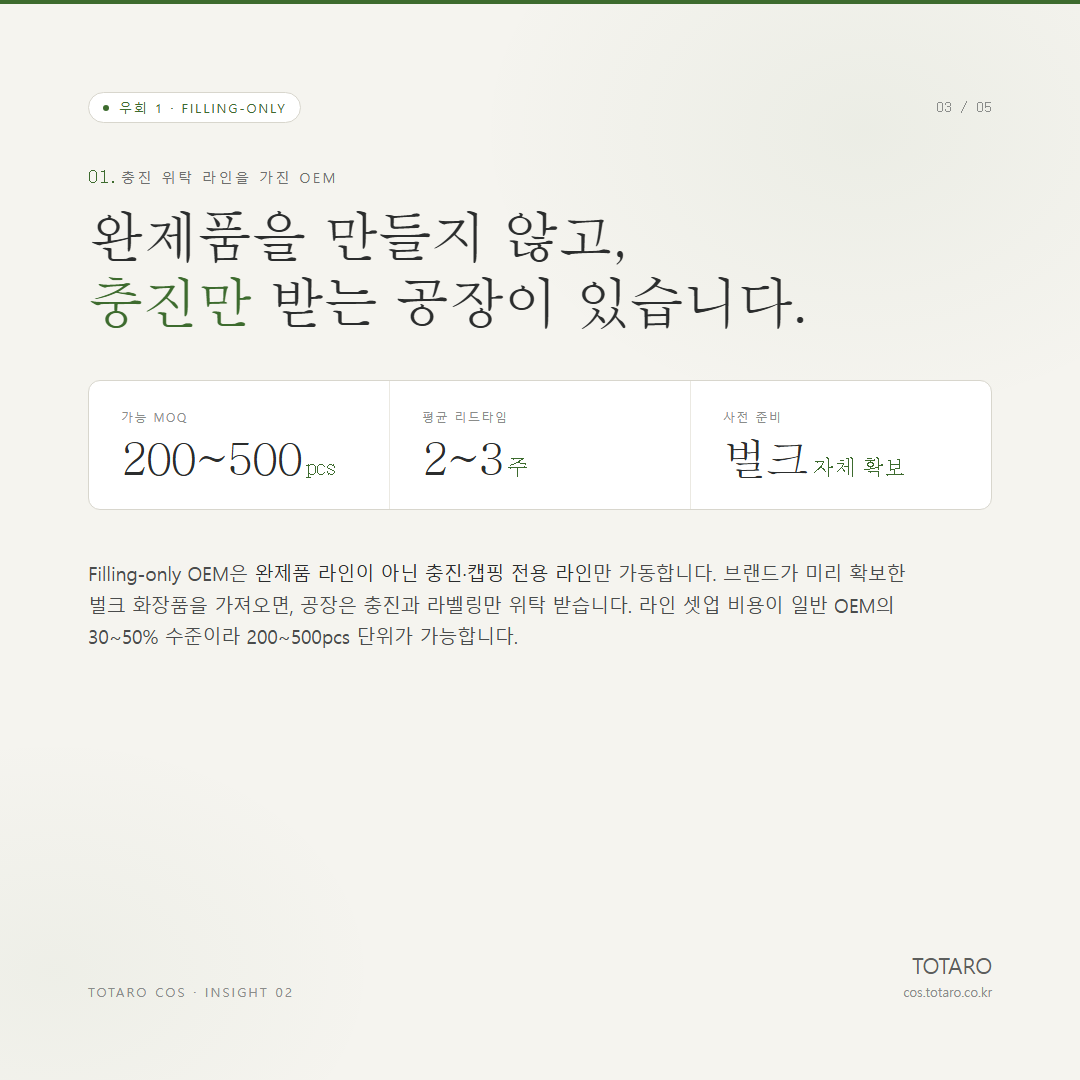
Workaround 1 — Filling-only Lines
MOQ 200–500 units / lead time 2–3 weeks
Some OEMs run filling and labeling only — not formulation. The buyer brings their own bulk and formula; the line just packs.
- Pro: Lowest MOQ, fastest turnaround.
- Con: You must source the bulk and formulation separately (ingredient supplier + chemist).
- Fit: Brands with their own formula, niche packaging (e.g., 1g sachets, single-use foils).
About 30–50 filling-only lines exist in the K-beauty market. Most are not listed in OEM catalogs.
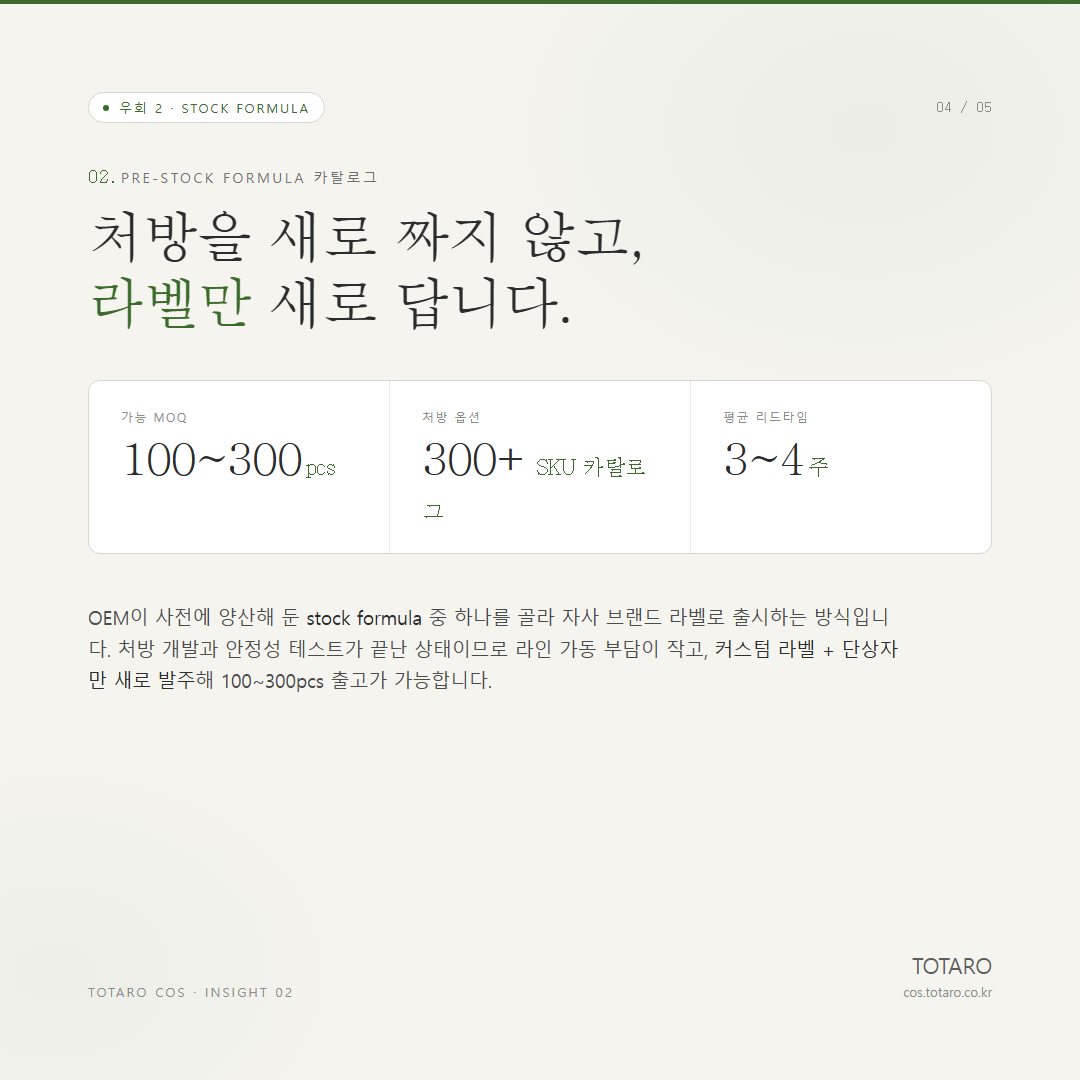
Workaround 2 — Stock Formula Catalogs
MOQ 100–300 units / lead time 3–4 weeks
The OEM keeps a library of pre-developed shared formulas. You pick one, change the label, and ship. This is the narrow definition of Private Label.
- Pro: Zero R&D time, lowest MOQ.
- Con: Limited differentiation — other brands may use the same formula.
- Fit: Market-test phase, time-to-market priority, price competition.
Major ODMs (Cosmax, Kolmar Korea, Kosmecca) all run stock-formula catalogs — typically 300–500 base formulas each.
Workaround 3 — Co-purchase / Shared OEM
MOQ 100–500 units per brand / lead time 6–10 weeks
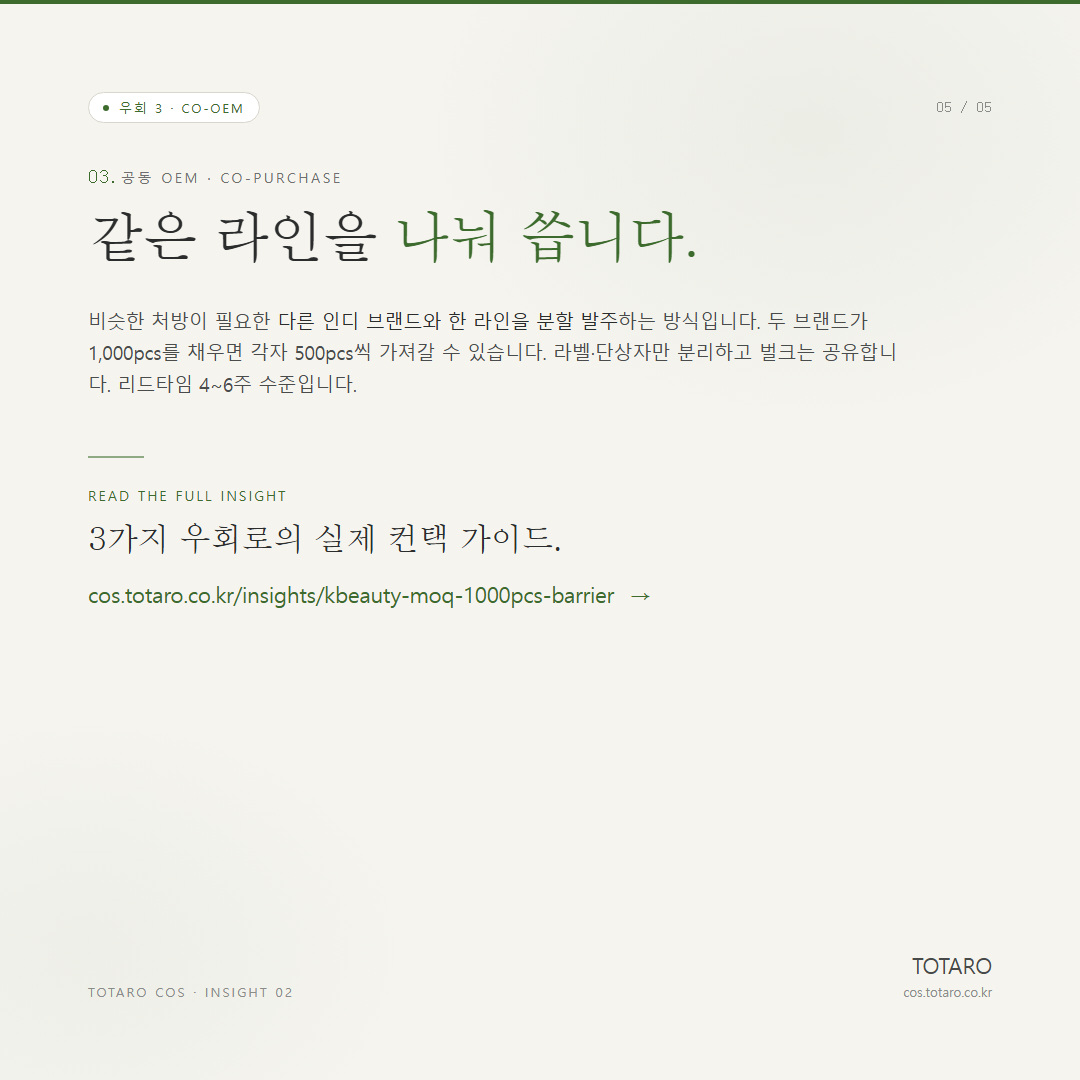
Several indie brands share one OEM line. A single setup produces 1,000–3,000 units; brands split via labels and packaging.
- Pro: Differentiation (custom formula possible) + distributed MOQ.
- Con: Brand-matching itself is the hardest step.
- Fit: When you have a network of indie brands with a similar concept.
Sometimes spotted on K-beauty Kickstarter / Wadiz pages. The Korean Cosmetic Industry Association indie chapter also runs informal matching.
Comparison — Three Workaround Paths
| Path | MOQ | Lead time | Differentiation | Entry difficulty |
|---|---|---|---|---|
| Filling-only | 200–500 | 2–3 wk | Med | Med (need bulk) |
| Stock formula | 100–300 | 3–4 wk | Low | Low |
| Co-purchase | 100–500/brand | 6–10 wk | High | High (matching) |
How TOTARO's Matching Solves This
In TOTARO supplier search you can set MOQ to <500 and get only OEMs matching one of these three paths. The Filling-only / Stock-formula categories appear as standalone filters.