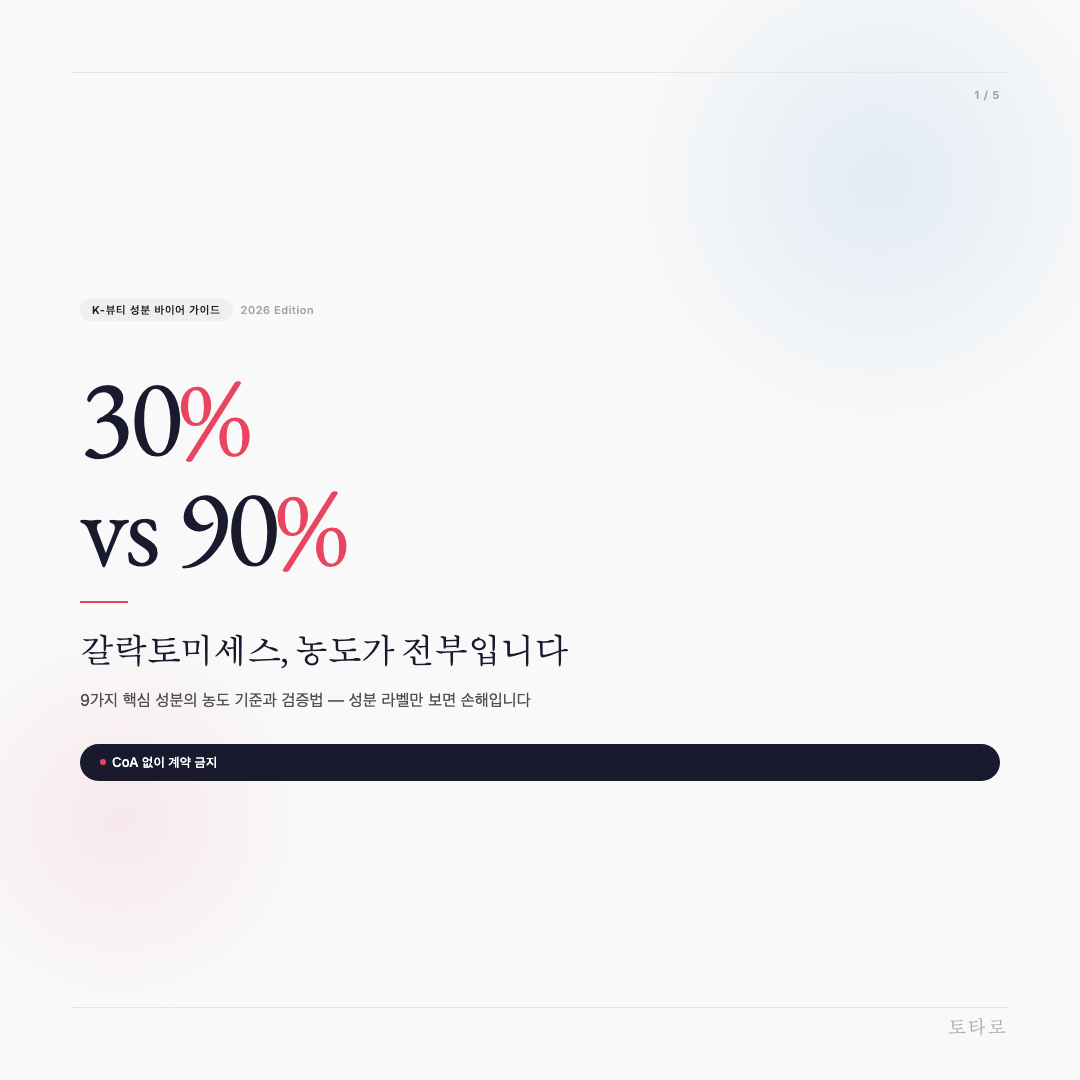
K-Beauty Ingredient Buyer's Guide 2026 — 9 Key Actives from Galactomyces to Tranexamic Acid
May 15, 2026
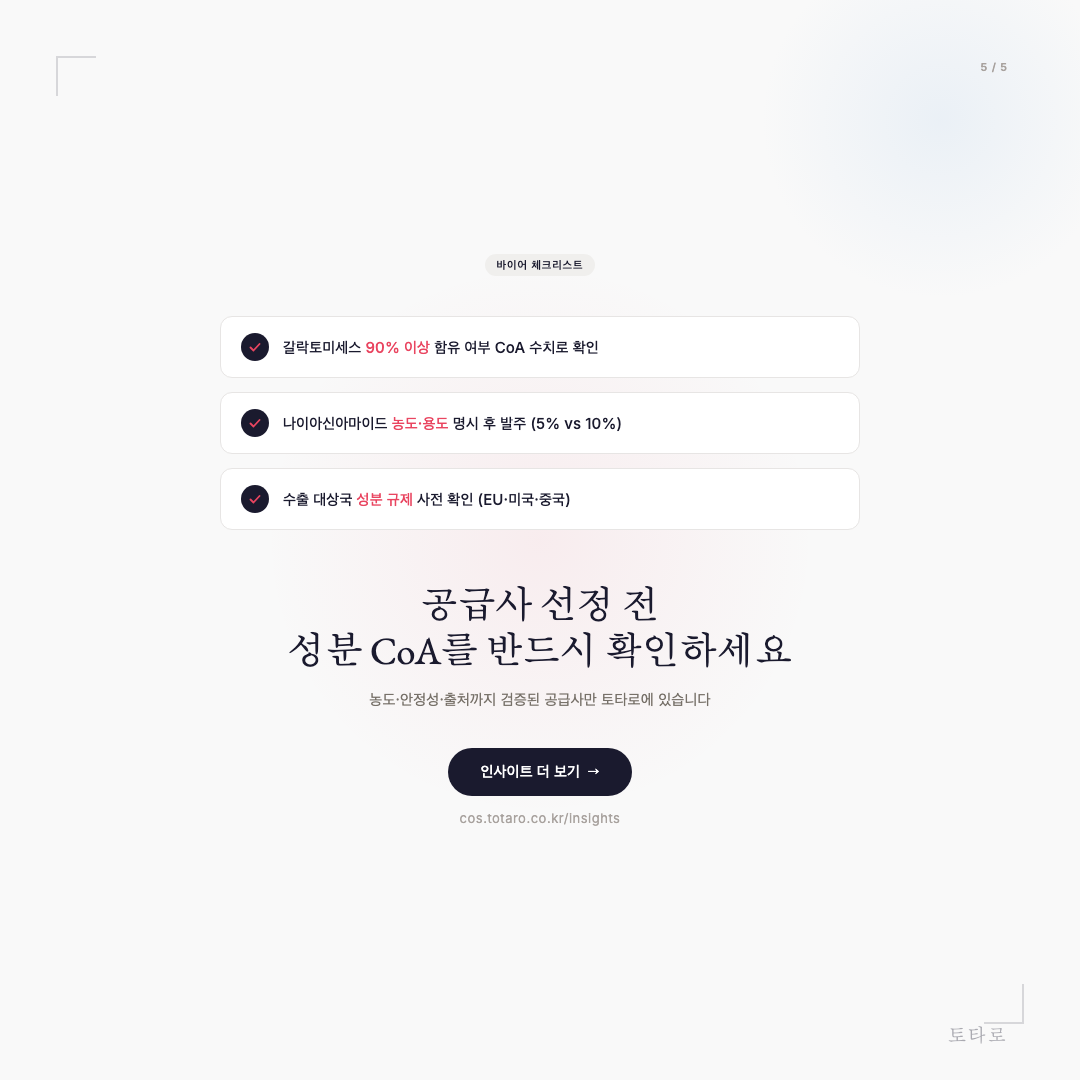
This piece is a card-news set. Swipe through the carousel above for the full visual breakdown.
Why Ingredient Knowledge Matters
Choosing a K-beauty manufacturer based on the ingredient label alone leaves money on the table. The same INCI name can deliver vastly different results depending on concentration, stabilization technology, and raw material origin.
This guide covers the 9 K-beauty hero actives of 2026 from a buyer's perspective — with target concentration ranges, label verification steps, and manufacturer evaluation checkpoints for each.
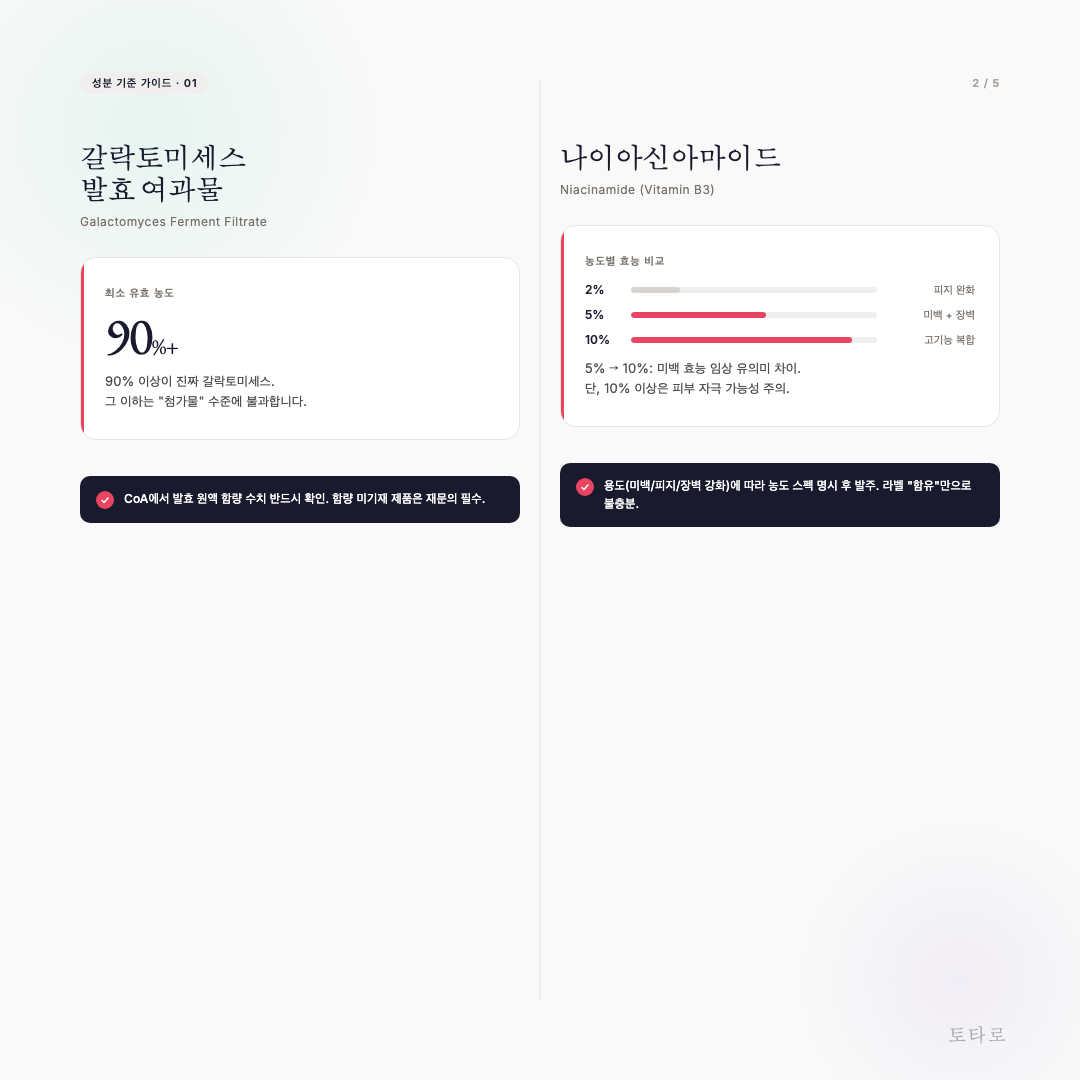
1. Galactomyces Ferment Filtrate
Function: pore minimizing · skin texture evening · brightening
Concentration Benchmarks
| Expected efficacy level | Recommended concentration |
|---|---|
| Texture improvement (entry) | 10–30% |
| Pore + texture (standard) | 50–70% |
| High-concentration (flagship) | 90%+ |
SK-II's Pitera popularized galactomyces, but K-beauty rewrote the category with 90%+ single-active essences (COSRX, Some By Mi, etc.).
Buyer Checkpoints
- 📋 Request a Certificate of Analysis (CoA) for ferment filtrate purity
- 🔍 INCI: Galactomyces Ferment Filtrate — do not confuse with Saccharomyces ferments
- ⚠️ Products at 90%+ should include mandatory patch-test language on-label
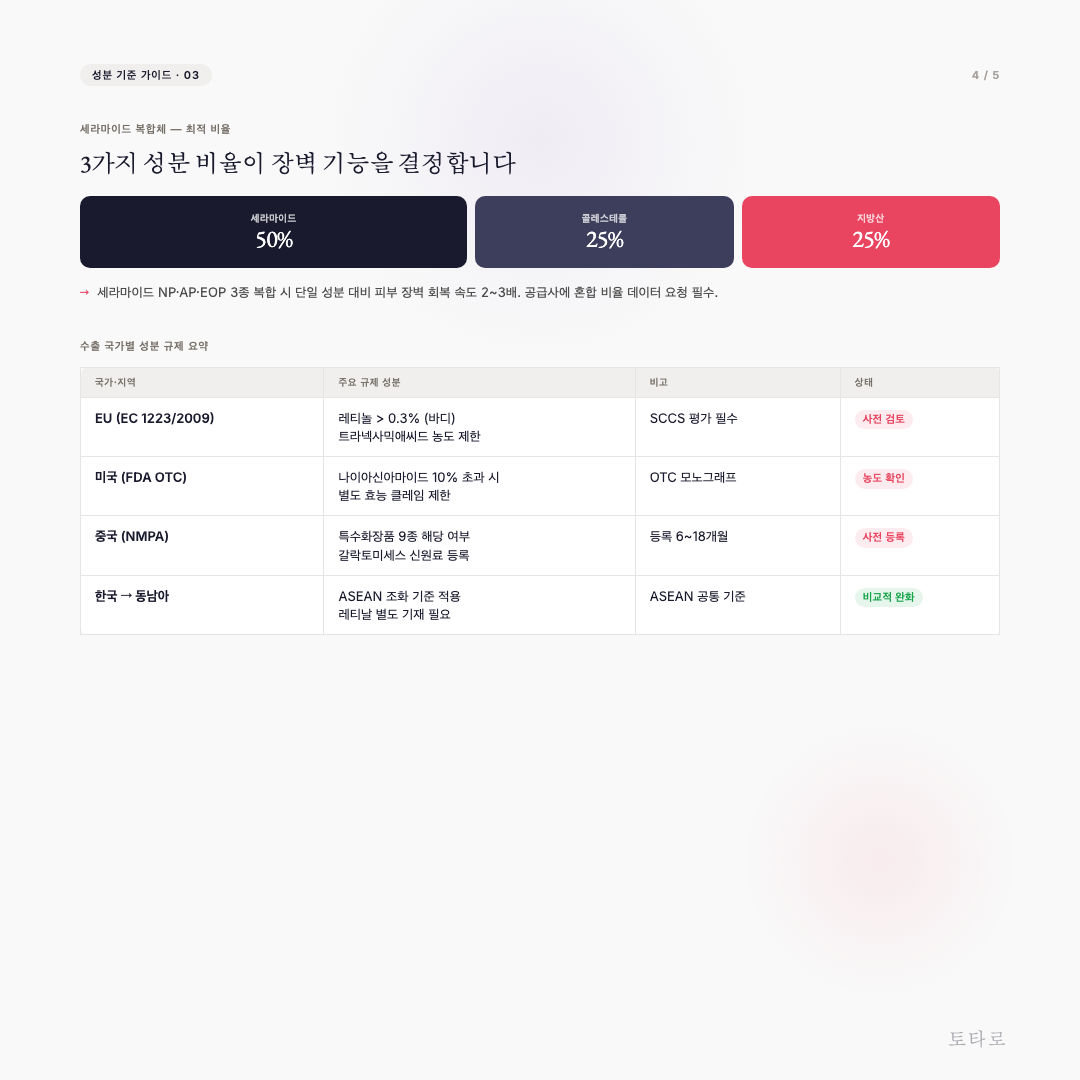
2. Ceramide Complex
Function: barrier repair · TEWL reduction · irritation relief
Concentration Benchmarks
Ceramide concentration alone is less important than the complex ratio:
| Component | Natural barrier ratio | Recommended blend |
|---|---|---|
| Ceramide 1 (EOP) | 35% | 3:1:1 ratio |
| Ceramide 3 (NP) | 40% | — |
| Ceramide 6-II (AP) | 25% | — |
Some K-beauty OEMs now offer biomimetic ceramide complexes blended at near-physiological ratios. Demand the exact ratio, not just "contains ceramides."
Buyer Checkpoints
- 📋 Verify INCI lists at least 2–3 ceramide type designations
- 🔍 High-ceramide formulas can feel heavy — emulsifier technology matters
- ⚠️ Distinguish synthetic ceramide analogs (Ceramide NP, AP, EOP) from phytosphingosine
3. Centella Asiatica / Cica
Function: soothing · anti-inflammatory · wound-healing · capillary strengthening
Concentration Benchmarks
| Type | Concentration |
|---|---|
| General extract | 0.5–5% |
| Madecassoside | 0.05–0.2% |
| Asiaticoside | 0.025–0.1% |
K-beauty Cica products vary widely. Purified actives (madecassoside / asiaticoside) vs general extract is a critical distinction — purified actives cost more but deliver reproducible results.
Buyer Checkpoints
- 📋 Ask for the madecassoside-to-extract blend ratio
- 🔍 Verify "Cica" is backed by actual R&D data, not just trend naming
- ⚠️ Unstable pigmentation at high extract concentrations — packaging material matters
4. Niacinamide
Function: brightening · sebum control · pore minimizing · barrier reinforcement
One of the most widely used K-beauty actives. 5% vs 10% is a common marketing claim — but the nuance matters.
Concentration Benchmarks
| Concentration | Efficacy | Irritation risk |
|---|---|---|
| 2–5% | Entry brightening · barrier support | Low |
| 5–10% | Brightening · pore · sebum reduction | Caution for sensitive skin |
| 10–20% | Clinical-level efficacy | Flushing/tingling possible (niacin conversion) |
Buyer Checkpoints
- 📋 Require niacinamide purity CoA (98%+) — low purity causes flushing from nicotinic acid impurities
- 🔍 Stable pH range: 5.5–7.0 — degrades in low-pH vitamin C formulations
- ⚠️ Request nicotinic acid content test results for 10%+ products
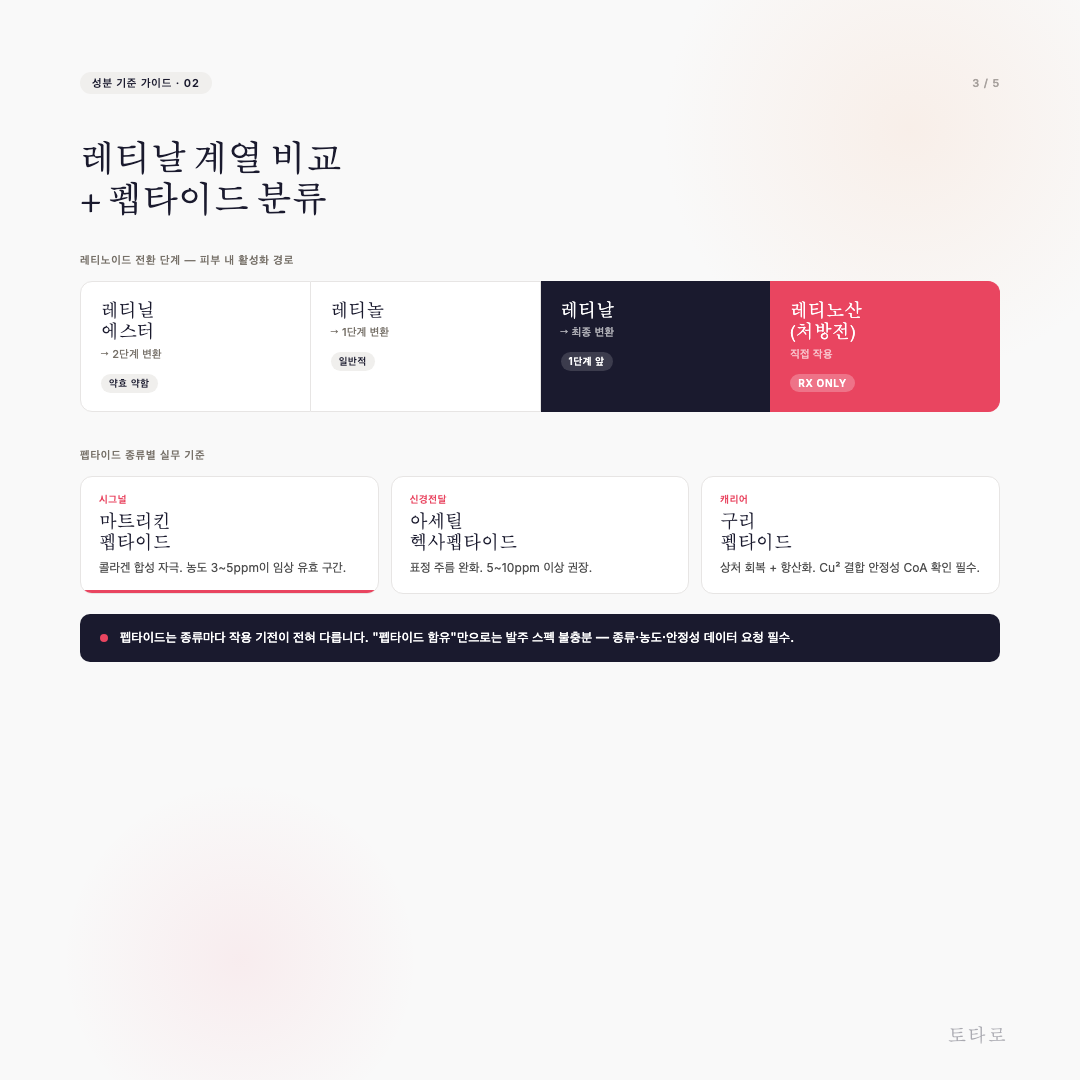
5. Retinal (Retinaldehyde)
Function: anti-aging · wrinkle reduction · cell renewal · pigmentation improvement
Retinal is one conversion step closer to retinoic acid than retinol. K-beauty manufacturers accelerated the retinol → retinal shift from 2024 onward.
Retinoid Comparison
| Active | Conversion steps | Irritation | K-beauty adoption |
|---|---|---|---|
| Retinyl palmitate | 3 steps | Very low | Common |
| Retinol | 2 steps | Low–medium | Mainstream |
| Retinal | 1 step | Medium | Growing fast |
| Retinoic acid (tretinoin) | Active form | High | Prescription |
Concentration Benchmarks (retinal)
- Entry: 0.01–0.03%
- Standard: 0.05–0.1%
- High-efficacy: 0.1–0.2% (expert recommendation)
Buyer Checkpoints
- 📋 Retinal is light- and air-sensitive — airless pump or opaque packaging required
- 🔍 Confirm INCI: Retinaldehyde not Retinol — they are different compounds
- ⚠️ Pregnancy warning label is mandatory in most markets — confirm export country requirements
6. Peptides
Function: collagen synthesis signaling · muscle relaxation (Botox-like) · barrier support
Peptides span dozens of distinct compounds. Knowing the type is essential.
Key Peptide Types
| Peptide | Mechanism | Effective concentration |
|---|---|---|
| Palmitoyl Tripeptide-1 | Collagen synthesis signal | 0.001–0.01% |
| Acetyl Hexapeptide-3 (Argireline) | Expression muscle relaxation | 3–10% |
| Palmitoyl Pentapeptide-4 (Matrixyl) | Collagen + HA synthesis | 0.005–0.05% |
| Copper Peptide (GHK-Cu) | Regeneration · antioxidant | 0.1–1% |
Buyer Checkpoints
- 📋 Solubilization method and pH stability determine efficacy more than concentration alone
- 🔍 Look for fatty acid conjugation ("Palmitoyl") in INCI — affects skin penetration rate
- ⚠️ Ionic interactions exist — validate compatibility with low-pH AHA/BHA formulations
7. Beta-Glucan
Function: soothing · hydration · antioxidant · immune modulation
A powerful alternative to hyaluronic acid. Some studies show deeper penetration than HA.
Concentration Benchmarks
| Concentration | Efficacy | Application |
|---|---|---|
| 0.1–0.5% | Soothing support | Multi-ingredient formula |
| 0.5–2% | Hydration + soothing (single target) | Essence · serum |
| 2–5% | High-concentration moisture + barrier | Specialty serum |
Buyer Checkpoints
- 📋 Distinguish oat-derived vs yeast-derived — oat beta-glucan has superior stability
- 🔍 High-MW forms excel at moisture-film formation; low-MW forms penetrate deeper
- ⚠️ Synergy with hyaluronic acid — confirm combination ratios
8. Tranexamic Acid
Function: brightening · PIH reduction · melanin synthesis inhibition
Rising fast in K-beauty as a more potent brightener than niacinamide.
Concentration Benchmarks
| Concentration | Efficacy |
|---|---|
| 1–2% | Maintenance · mild brightening |
| 3–5% | Clinical-range efficacy |
| 5–10% | Targeted PIH correction (near-prescription) |
Buyer Checkpoints
- 📋 Most stable at pH 4.5–6.5 — request manufacturer pH data
- 🔍 Synergistic with niacinamide; verify stability when combined with retinol
- ⚠️ High concentrations (10%+) may be classified as pharmaceutical in some markets — check export regulations
9. Panthenol (Pro-vitamin B5)
Function: moisturizing · wound healing · soothing · hair strengthening
A low-irritation workhorse. Concentration and combination design determine outcome.
Concentration Benchmarks
| Concentration | Application |
|---|---|
| 0.1–0.5% | Light moisturizing support |
| 1–5% | Barrier recovery · moisture retention |
| 5–10% | Intensive repair (post-sun · sensitive) |
Buyer Checkpoints
- 📋 Synergy with ceramides and niacinamide for barrier reinforcement
- 🔍 D-panthenol preferred over DL-panthenol — D-form has higher biological activity
- ⚠️ Minimal irritation even at 5%+ — ideal for sensitive-skin product lines
Ingredient Sourcing Checklist
Verify these before accepting samples from any manufacturer.
Documents to request
- Raw material origin + CoA for each key active
- Actual vs labeled concentration verification
- pH, viscosity, and stability test data (accelerated 3–6 months)
- Preservative system and MIC values
Label verification
- INCI names match ISO 16128 standard nomenclature
- Claimed concentrations align with published efficacy thresholds
- No restricted/prohibited ingredients for target export markets (EU Cosmetics Regulation, FDA 21 CFR, etc.)
Regulatory Summary by Active
| Active | EU | US | JP |
|---|---|---|---|
| Niacinamide | Unrestricted | Unrestricted | Unrestricted |
| Retinal (≤0.05%) | Permitted | Permitted | Permitted |
| Tranexamic Acid (≤3%) | Permitted | Permitted | Permitted |
| Galactomyces Ferment Filtrate | Permitted | Permitted | Permitted |
| Ceramides | Unrestricted | Unrestricted | Unrestricted |
Regulations change frequently. Always verify against the latest local rules before export.
Next Steps
→ GMP 5-Minute Audit Checklist