Korean Sunscreen OEM Guide — Why Sunscreen Is the Trickiest Category to Source
May 16, 2026
This piece is a card-news set. Swipe through the carousel above for the full visual breakdown.
TL;DR
Sunscreen is the strongest category in K-beauty exports. A light feel, no white cast, modern UV filters — it is the first thing many global buyers ask for.
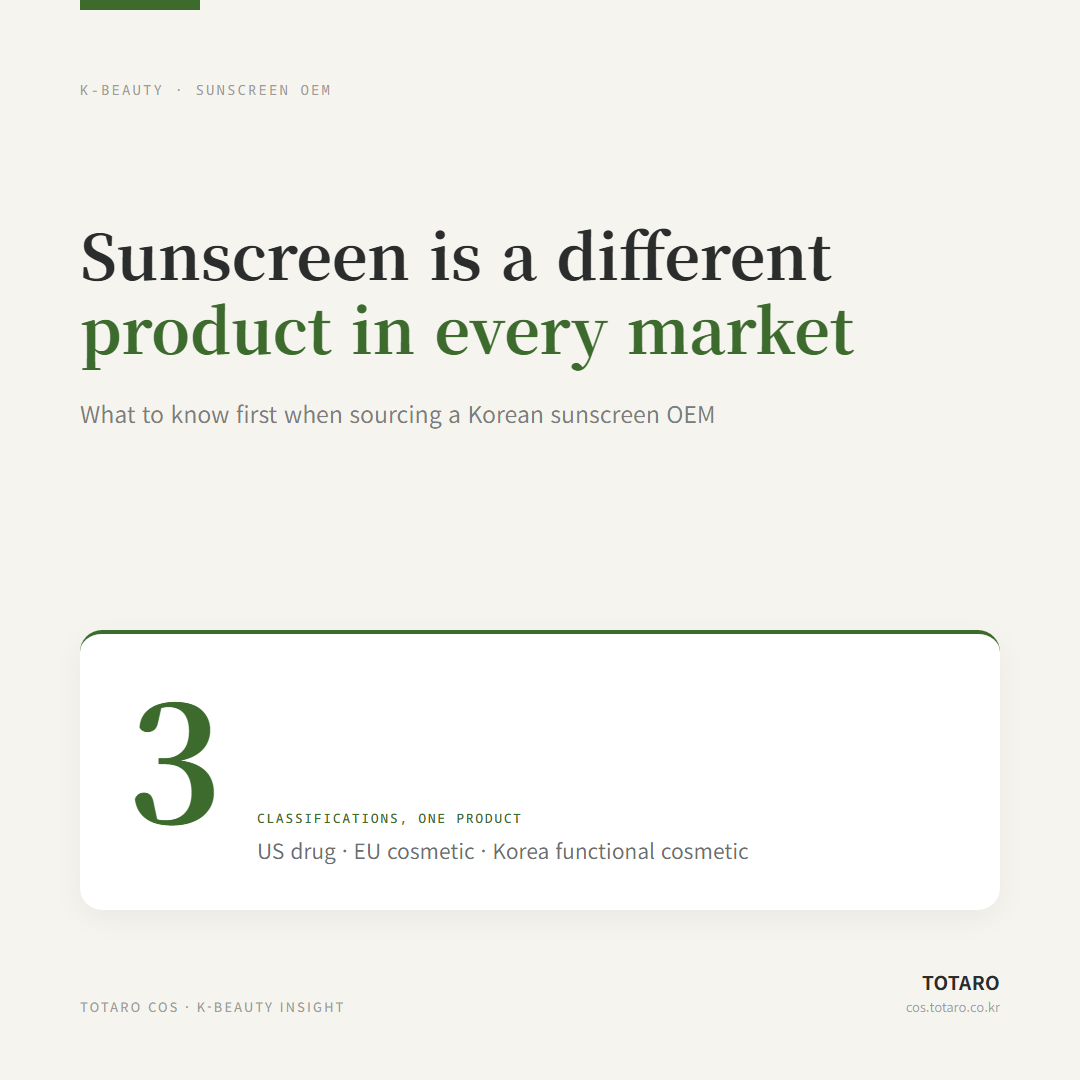
But sourcing a sunscreen OEM is far trickier than any other cosmetic. There is one reason — sunscreen is legally classified differently in every market.
- USA: OTC drug (FDA monograph)
- EU, most of SE Asia, etc.: cosmetic
- Korea: functional cosmetic (MFDS review / report)
This piece covers:
- Why buyers seek out Korean sunscreen
- How the classification gap shapes OEM selection
- The UV filter split between US-bound and global formulas
- The SPF / PA test reports you must obtain
Why Buyers Seek Out Korean Sunscreen
Korea regulates sunscreen as a functional cosmetic. UV protection requires MFDS review or reporting, and an SPF/PA claim can only be printed after the product passes defined testing. The system itself pushed formulation skill and label credibility upward.
The result: Korean OEMs lead on no white cast, light wear, and makeup compatibility. The format range is wide — tone-up, serum-type, stick. That is why "Korean sunscreen" became a category of its own in search and reviews.
But the same strength can be a trap — a formula optimized for the Korean market may not be sellable as-is in your export market.
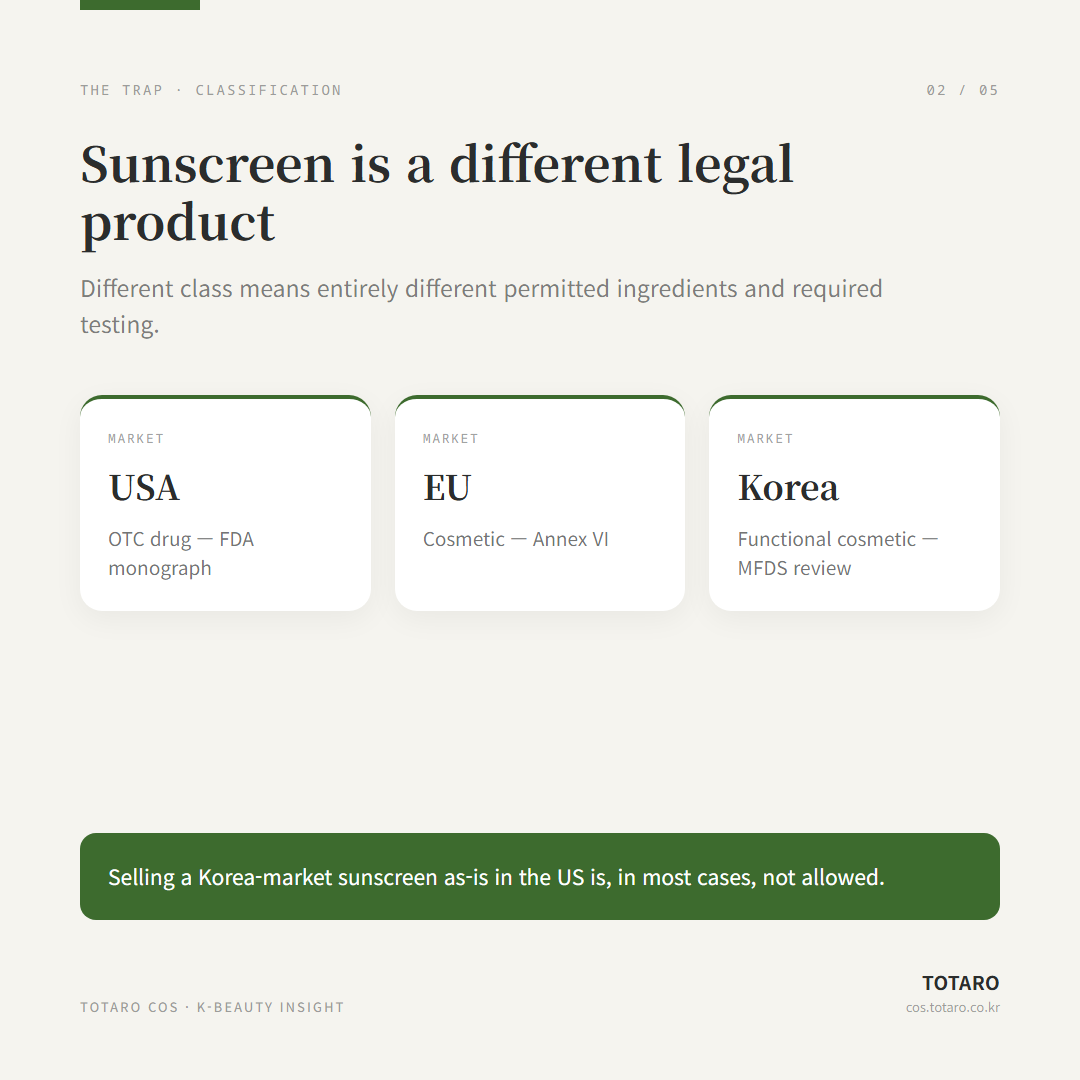
The Trap — Sunscreen Is a 'Different Product' in Every Market
Different legal classification is not just paperwork. It means the permitted ingredients and the required testing change entirely.
| Market | Class | UV filter rule | Core testing |
|---|---|---|---|
| USA | OTC drug | FDA monograph (almost no new filters approved) | SPF in-vivo, water resistance |
| EU | Cosmetic | Annex VI (modern organic filters allowed) | SPF, UVA-PF |
| Korea | Functional cosmetic | MFDS notice (similar to EU) | SPF, PA |
| SE Asia | Cosmetic (varies by country) | ASEAN cosmetic directive | SPF, PA/UVA |
The USA treats sunscreen as a drug, so selling there means the formula, the label, and manufacturing all follow OTC rules. Listing a Korea-market sunscreen on US Amazon as-is is, in most cases, simply not allowed.
"The most common buyer mistake is requesting quotes before fixing the target market. A US product and an EU product are different from day one." — Korean sunscreen OEM development team, April 2026
UV Filters — Where US and Global Split
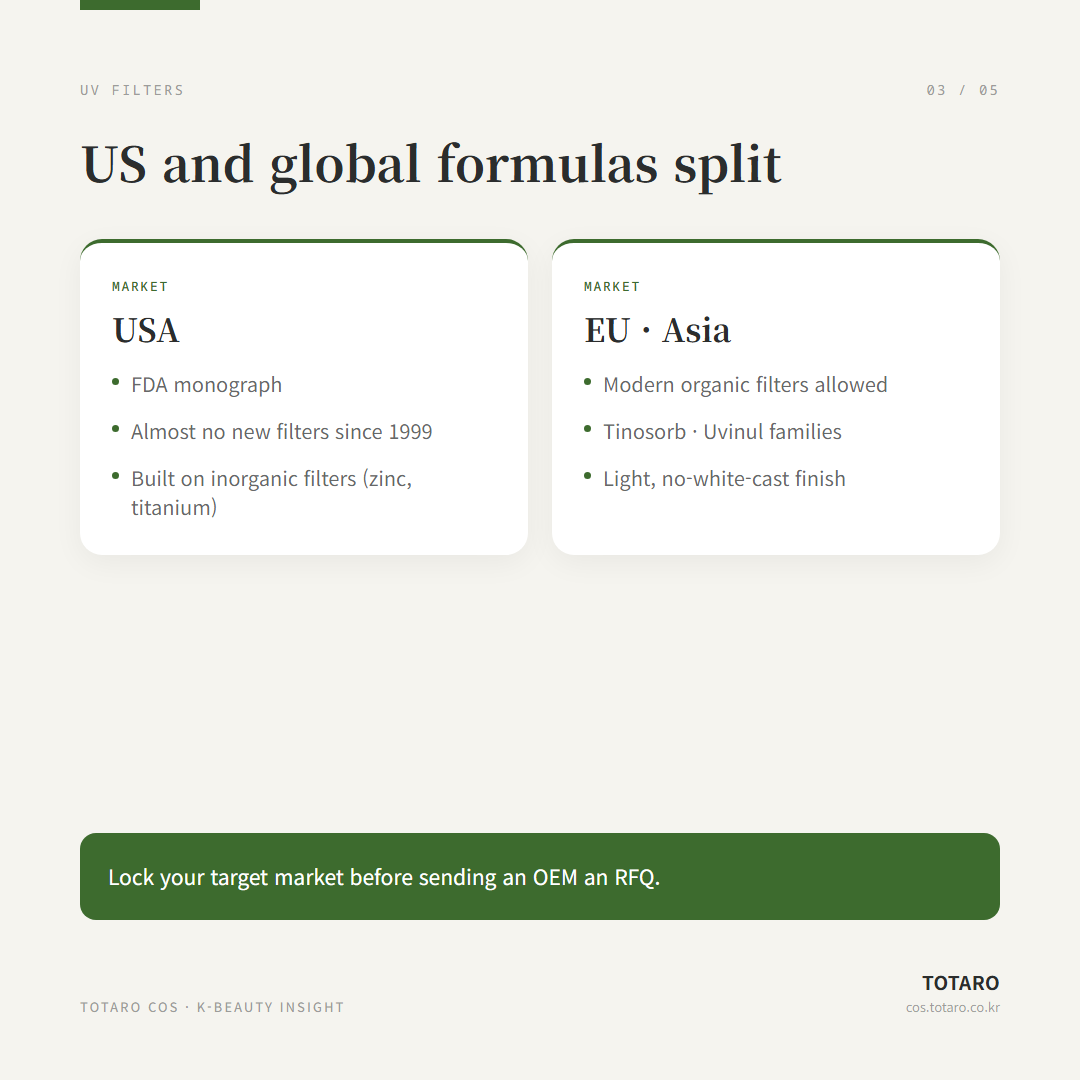
The decisive difference is the UV filter.
The EU and Korea permit modern organic filters such as the Tinosorb and Uvinul families. They are photostable and light on the skin — the core of that signature Korean finish.
The US FDA monograph, however, has approved virtually no new filters since 1999. US-bound sunscreen has to be built around older organic filters and inorganic filters (zinc oxide, titanium dioxide).
The conclusion is clear — a "US export" sunscreen and an "EU/Asia" sunscreen are different formulas from the start. That is why you must lock the target market before sending an OEM an RFQ.
SPF / PA Test Reports — What to Collect
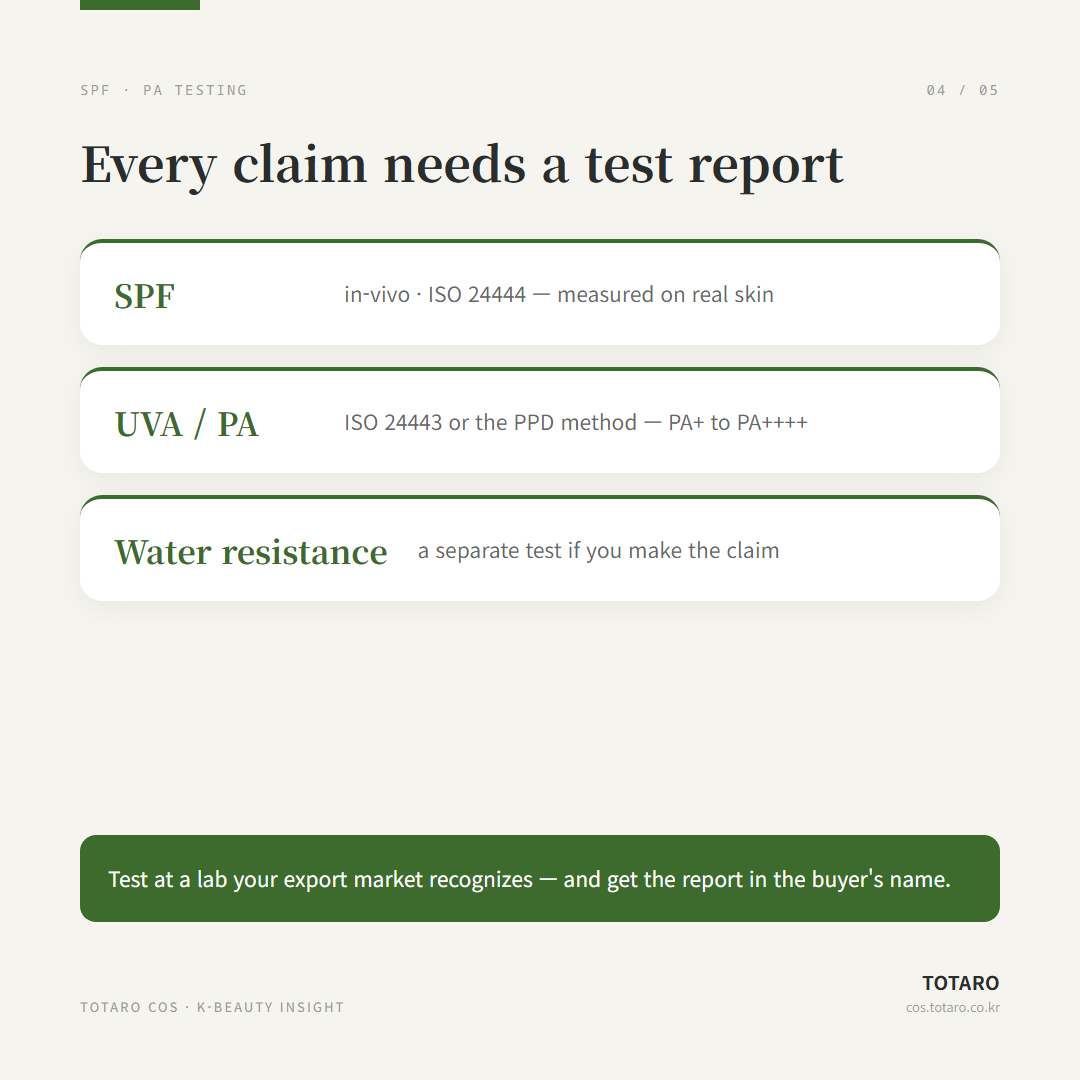
An SPF/PA claim must be backed by a test report.
- SPF (in-vivo): ISO 24444. Measured on real human skin.
- UVA / PA: ISO 24443 (in-vitro) or the PPD method. Korea and Asia label it PA+ to PA++++.
- Water resistance: a separate test if you want the claim.
Testing costs time and money, and it must be done at a lab recognized by your export market. Check whether the OEM runs testing for you and can issue the report in the buyer's name.
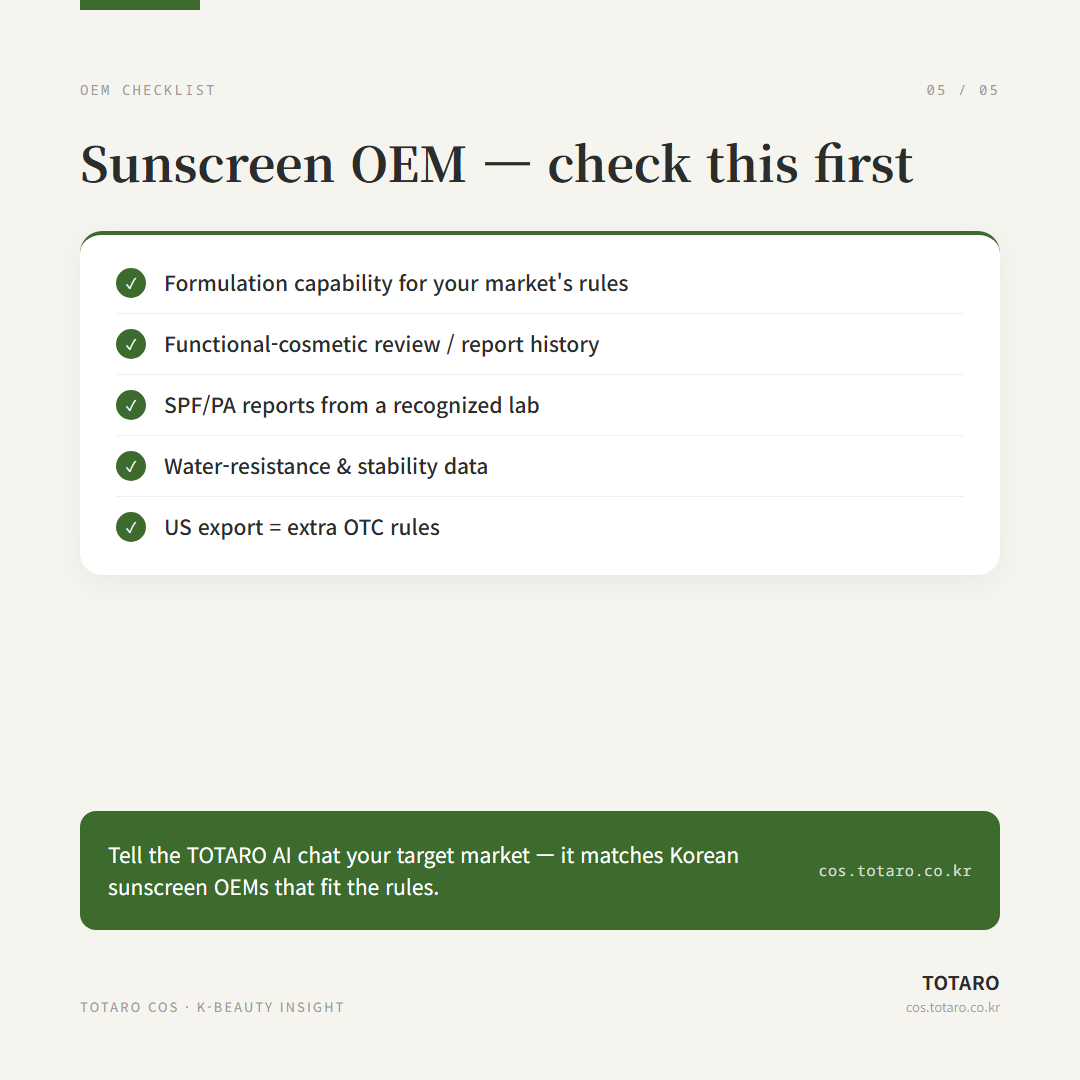
Sunscreen OEM Selection Checklist
- Formulation capability for your target market's rules — US vs global
- Functional-cosmetic review / report history — a credibility signal in Korea
- SPF/PA test reports from a lab your target market recognizes
- Water-resistance and stability test data
- For US export — sunscreen is an OTC drug, so extra manufacturing and labeling rules apply
How TOTARO's Matching Solves This
Tell the TOTARO AI chat your target market (US, EU, SE Asia) and the format you want, and it surfaces only Korean OEMs with formulation capability for that market's rules and the SPF/PA test reports to back it. It filters out mismatches — like a US product formulated with EU filters — before the quote stage.